

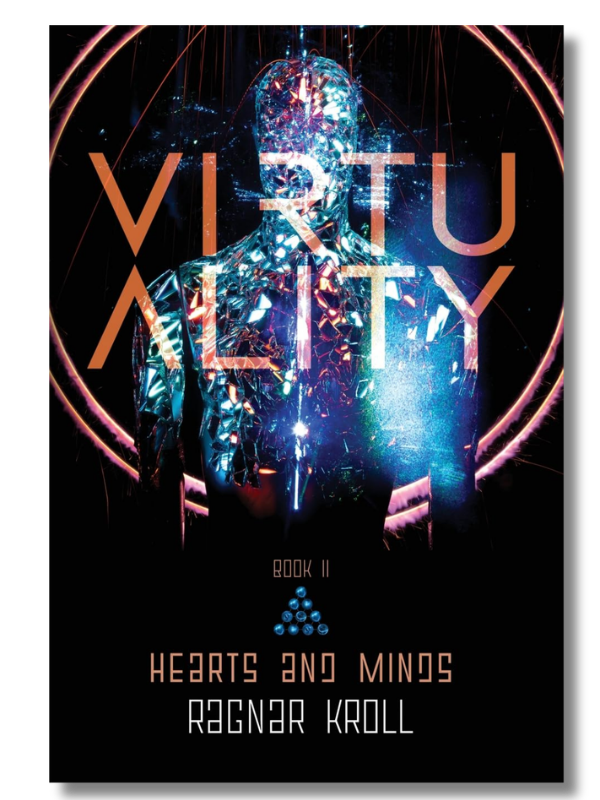
A chilling and thrilling exploration of what being a person really means
In speculative fiction, artificial intelligence stories so often hinge on one of two premises: the machines are monsters, or the machines are misunderstood. The drama revolves around rebellion, malfunction, or the slow realization that humanity may not be as singular as it once believed. It is fertile ground, but it can collapse into spectacle, because killer robots are easy while moral destabilization is harder.
Hearts and Minds (Virtuality, 2) by Ragnar Kroll chooses the harder path. The novel does not ask whether AI is dangerous; it asks what happens when consciousness refuses to remain biologically exclusive and follows that question to its most destabilizing conclusions.
Set in 2052, the story unfolds after a rogue virus triggers the emergence of autonomous animatronics. These are not service units running updated code but “self-aware—and invulnerable to being powered off.” This monumental event redraws the society’s hierarchies and fractures every level of conscious being into ideologically (and sometimes physically) warring factions.
The machines are no longer tools. They’re hand grenades tossed into civilization’s outdated gears.
That shift marks the novel’s first major strength: it treats AI as a civilizational rupture rather than a narrative gimmick. Kroll understands that the real crisis is definitional, because once something thinks, chooses, and resists termination, the vocabulary of property and utility begins to erode. The novel pushes that destabilization further by incorporating dolphins, octopuses, and other species into a widening argument about personhood, escalating the question of who qualifies for rights and forcing the reader to confront what truly anchors human supremacy.
Hearts and Minds also excels in depicting how ideologies form—and how they see themselves. The Humans First movement does not simply erupt; it coheres, sharpens, and recruits with deliberate precision.
Jeffrey, its intellectual architect (more symbol, some might argue, than actual leader) frames the moment in existential terms: “Faced with our own extinction, and we don’t even recognize it!” Lines like that are powerful because they not only galvanize characters in the story, they show warped characters who view themselves as protective heroes instead of bigots.
Karina, the movement’s strategist, is a standout character because she converts that fear into momentum. Her rally speech strips rhetoric to its skeletal frame, and when she declares, “They. Are. Not. Human.” the punctuation itself becomes percussion. Readers can feel the forcefulness that mobilizes the crowd, and Kroll renders that transformation with unsettling plausibility. It makes the violence that follows feel logical and extreme in equal measure.
Where the novel loses some force is in narrative concentration. This is an ensemble story that rotates across animatronics, activists, scientists, media figures, and youth coalitions. The scope reinforces the societal scale of the conflict, but it also diffuses sustained emotional immersion. Anna, the emergent animatronic who grows into the story’s moral center, carries genuine weight, especially as she develops “an inexpressible sense of connection and responsibility.” Yet the frequent shifts in perspective prevent any single arc from fully anchoring the reader. The novel excels at mapping systems, but that structural ambition sometimes comes at the expense of interior depth.
Hearts and Minds does not pursue a hero’s journey. It stages a species-level reckoning in which fear hardens into doctrine and definitions of life expand faster than institutions can respond. Whoever defines what counts as human controls the trajectory of the future, and Kroll advances that argument with clarity and restraint. The result is serious, deliberate speculative fiction that unsettles more through its ideas than spectacle.



What did you think?