

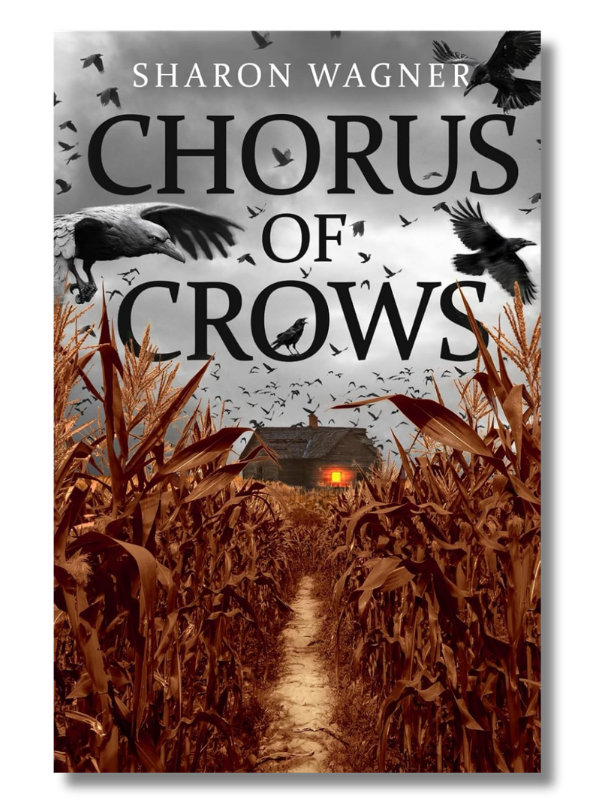
There is a particular kind of fear reserved for the moment you realize the threat is not outside the house, but inside the mind.
Some horror novels rely on brutality. Others lean into shock, excess, or relentless dread. Chorus of Crows takes a more unsettling, and frankly more difficult, path; it seeps under the skin slowly, threading grief, memory, and psychological fracture into something that feels intimate rather than theatrical.
From its opening pages, Author Sharon Wagner establishes a tone that is eerie but grounded. Sedona, a flight attendant suspended between a glittering escape in Miami and a reluctant return to rural Wisconsin, is introduced through the rhythms of ordinary life; airports, lovers, exhaustion, routine. That normalcy is essential because the horror that follows does not erupt, it intrudes. A flicker. A distortion. A moment that feels wrong before it feels frightening.
What Wagner handles especially well is restraint. The novel delivers a persistent creep factor without tipping into gratuitousness. The unease builds through atmosphere, perception, and the quiet erosion of certainty. Sedona’s hallucinations aboard the plane, particularly the chilling transformation of a familiar face into something grotesque, set the stage for a story that is less about monsters and more about the terrifying instability of the mind.
When Sedona returns home to care for her father, Oren, the novel deepens into something richer and darker. The rural setting is not romanticized. Bird Hall is rendered with a stark clarity; empty fields, old furniture, community rituals, and the heavy, lingering presence of the past. Grief saturates everything. The house. The barn. The dreaded “spot” behind it.
Oren’s Parkinson’s disease is not merely background detail but an emotional and narrative anchor. His physical decline, tremors, and creeping disorientation are written with compassion and brutal honesty. His loneliness, his vulnerability, and his own encounters with what may or may not be real introduce a second layer of dread that mirrors Sedona’s unraveling. The horror here is deeply human; aging, illness, memory, regret.
Thematically, the storylives at the intersection of trauma and perception; it explores how unresolved grief distorts reality, how guilt calcifies, and how the past refuses burial. The supernatural elements remain tantalizingly ambiguous. Are these visitations, manifestations, or fractures in consciousness? Wagner wisely resists easy answers.
The writing itself is engaging and confident. Passages flow with an almost deceptive smoothness, making the novel compulsively readable even as tension tightens. There are several genuinely heart-pounding sequences, yet the novel’s greatest strength lies in its quieter moments; the conversations edged with resentment, the small-town Wisconsin interactions, the suffocating weight of memory.
Even the character names, distinctive without feeling forced, lend the novel a slightly off-kilter quality that suits the story’s mood. Nothing feels generic. Nothing feels lazy.
As a horror reader who is both devoted and admittedly difficult to impress, I found Chorus of Crows refreshingly effective. It unsettles without exhausting and frightens without relying on gore. It delivers a mystery that pulls the reader forward rather than battering them into submission.
This is a novel for readers who appreciate psychological horror, slow-building dread, and stories where emotional realism amplifies the fear. Chorus of Crows is not interested in cheap scares. It is interested in what lingers.
And remember, “If you are awoken by a strange sound, make a stranger sound.” (Jarod K. Anderson, The Haunted Forest Trilogy)




What did you think?