

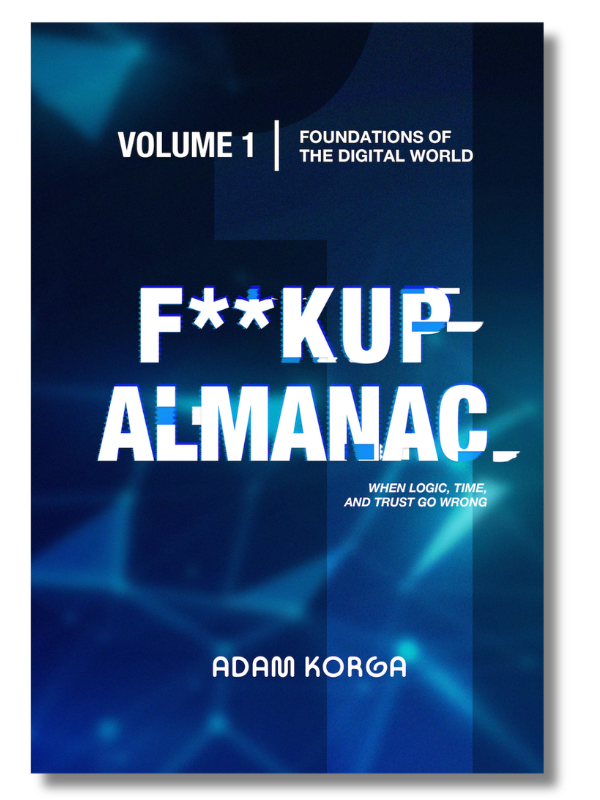
With sly wit and powerhouse knowledge, Adam Korga helps readers laugh their way through the breakdowns of the digital world.
While some books ask readers to imagine new worlds, Fuckup Almanac, Volume I: Foundations of the Digital World asks that we look more carefully at the fascinating, sometimes messy one we live in now. In doing so, author and technologist Adam Korga pulls back the curtain on the digital systems we rely on every day and examining how they fail (often quietly and predictably) with both expert-level knowledge and wry, relatable wit.
Structured around post-mortems examining an array of technological failures, Fuckup Almanac, Volume I naturally looks at the damage already done by technology’s mishaps. This disciplined, un-sensational study of the past works well in helping readers understand the world we currently live in much better than other, more theoretical approaches of what might go wrong in the future. For non-technical readers, it is immensely helpful to see concrete examples and explanations of how today’s digital infrastructure—from computation and networking to data storage and safety systems—breaks down under pressure.
While the book looks at systemic technical breakdowns, it’s clear that the goal is understanding, not blame. However, it is skeptical of the kind of perforative motions that organizations go through after a crisis. Korga writes, “If your strategy is basically ‘clench fists, cross fingers, and hope,’ you don’t need a post-mortem. You need a prayer circle.” It’s a welcome statement, not just because it helps instill a no-nonsense, truth-telling mentality, but because it’s funny, setting both the tone and the expectations for what’s to come.
And speaking of what follows, the book moves outward from there in a welcome structure of deliberate layers. Early segments focus on digital fundamentals like math, logic, and timekeeping in chapters that describe how small computational quirks can snowball into consequences far beyond their original scope. Then, later sections turn to areas like networking and data storage, graduating to aspects of our digital infrastructure where the stakes start to feel more permanent. As Korga says when examining data loss, “Compute and network failures cause disruption; data failures cause amputation. Downtime hurts…but downtime ends…There is one irreversible exception in compute and network failures: human life.” Those kind of no-holdsbarred observations, peppered in alongside the humor, are some of the book’s strongest moments.
While it seems like it should go without saying, Korga’s deep familiarity with computer science and systems engineering is another big mark in Almanac’s favor. Of course, the sense of authority helps less back-end-tech-savvy readers feel like they’re in good hands, but the book’s confidence also lends it a sense of patience and clarity in its explanations. That comfort also helps Korga be more personal without losing sight of the necessary truths he’s trying to impart. Even in discussions of entropy, for instance—a topic that could easily drift into abstraction—there are moments of down-to-earth humor and reminiscence (in this, the author attempting to use science to not clean his room): “The universe was on my side. My mom was not.”
The book’s wide scope does occasionally work against it. Because Fuckup Almanac aims to surface patterns across many domains, some case studies feel necessarily brief. Readers who find themselves especially drawn to a particular incident may wish the author lingered a bit longer, particularly where human decision-making played a decisive role. A narrower focus might have allowed for deeper narrative texture in places.
That’s a modest critique, however, of a book that largely succeeds on its own terms. Fuckup Almanac, Volume I isn’t prescriptive, and it resists tidy conclusions. Instead, it asks readers to sit with complexity, recognizing how much of the digital world is held together by trust, habit, and the power of sheer optimism, and offers nothing but the steadier footing that comes from knowing where the cracks actually are.



What did you think?