

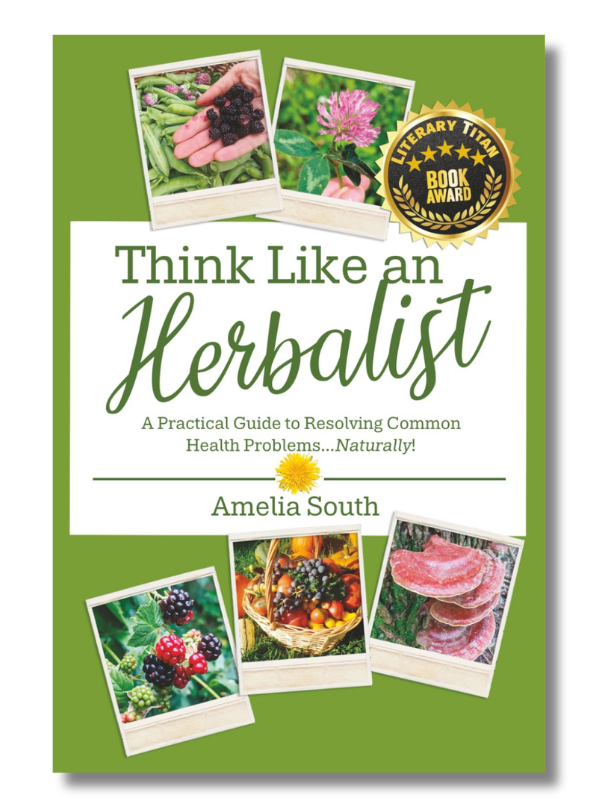
The rare wellness book that earns a skeptic’s shelf space.
Think Like an Herbalist sits squarely on the “practical wellness” shelf, where anecdote, folk tradition, and selective research mingle. What follows is a cultural and textual review, not a clinical guide, but a down-to-earth study.
South understands her audience; she knows her readers are exhausted and over-scheduled, so she’s built a book engineered for people whose days are already full, who are looking for practices they can actually sustain. That intentionality shows in the book’s design.
Think Like an Herbalist is approachable and methodically organized, steering clear of herbalism-as-aesthetic mood board vibes. It wants to be practical. It wants to be a reference you actually flip through. And, importantly, it does not spend its energy trying to talk readers out of conventional medicine, “There are some conditions you need a doctor to treat. Modern medicine can be miraculous when applied correctly.” Throughout the book, she repeats some version of: use common sense, don’t ignore alarming symptoms, and if you’re on medications you need to take interactions seriously.
The author locates herself in traditional western herbalism, not traditional Chinese medicine or Ayurveda. This boundary-setting does a few things. It limits scope, which makes the book more functional. It acts like a preemptive rebuttal to the reader who wants “all the systems” in one volume and would otherwise treat a 198-page guide like it’s the Library of Alexandria. And, importantly, it lends credibility to South’s experience in western herbalism by necessarily offering a specific tradition and framework. She wants readers to connect to her work, not worship it: “My book should be part of your library, not your only resource on herbalism.” Skeptical readers will appreciate the boundaries South puts up around her expertise.
South divides the book deliberately into two parts. Part One, “Prevention,” is a foundation that runs through big-ticket lifestyle basics: digestion and the gut, nutrients, food choices, hydration, movement, sleep, hygiene, even what you wear. Part Two, “Healing Remedies,” is a catalog of common complaints and what she would do and/or recommend to help address them, from pain and inflammation to immune support, skin issues, hormone imbalances, urinary issues, and more.
The table of contents alone is a pitch: gut, nutrients, food, hydration, movement, supplementation, sleep. It’s the unsexy basics most people half-know and rarely implement consistently. If you’re a reader who wants a single volume that starts with the boring fundamentals before it gets to the “here’s what to do when you’re sick” section, this structure will feel like relief. South writes between the reference tome and the vibe book: readable but oriented toward action. It doesn’t posture as esoteric medicine, and it doesn’t sell herbalism as an identity.
The author offers a worldview that many readers find motivating: the body is not a set of isolated problems but a network. It encourages readers to notice patterns and ask better questions. This can be valuable even if you never buy a single tincture. And she lowers the intimidation barrier greatly. People come to herbalism because they want agency and because the medical system can be expensive, rushed, and sometimes dismissive. South acknowledges that hunger for control without leaning into conspiracy. She validates the desire to understand your own body while still repeatedly advising readers to consult qualified professionals when things are serious or confusing.
South’s core pitch is not grow this herb and be cured. It’s closer to: stop treating symptoms like separate little villains and start reverse-engineering patterns. She’s openly impatient with the “quick fix” illusion, including the fantasy that an herb can do the emotional labor of changing your actual life. At one point she describes clients who want her to “say ‘take ashwagandha and you’ll be healed,’” and she makes good on her word to avoid miracle quick fixes. She simply refuses to play that game. That refusal is one of the book’s better instincts, and it lines up with what skeptical readers already know: a lot of the wellness market is symptom-chasing with nicer packaging.
South is a systems thinker. She wants the reader to get the order of operations right: foundations first, then remedies. The tone is conversational and confident, sometimes almost aggressively so, but the confidence is oriented toward process rather than miracle claims.
The chapters read like advice from a trusted friend who has done a ton of experimenting, made mistakes, and is now trying to spare you time and money. South repeatedly says some version of “I don’t know everything,” and she encourages readers to build a library rather than treating her book as the last word. She also makes space for medical care as a necessary tool, not a moral failure or betrayal of “natural living.” There’s a moment where she even says: if you cut your finger to the bone, don’t rub a plant on it and call it a day. Go get stitches. South explicitly warns about herb-drug interactions, tells readers to look things up if they’re on medication, and repeats that the remedies are written for someone not taking pharmaceuticals.
The main caution is the obvious one: a well-organized book can still launder shaky claims through confidence and momentum. South describes her approach as a blend of folk wisdom, general health knowledge, and personal experience. That is honest. It is also, from an evidence standpoint, exactly the category where charismatic certainty can outrun what the research actually supports. The book includes references, but of course this is different from “clinically demonstrated.”
If you want this book to be something it isn’t, a clinically rigorous guide to treating medical conditions, it will disappoint you and it should. If you want it to replace individualized care, it can’t and it says it won’t. The more interesting question is what it does as a cultural object: a readable, competent expression of the current “back-to-basics” wing of wellness, one that tries to be responsible about risk without abandoning the promise that you can feel better through daily decisions.
Think Like an Herbalist is a map of how a non-clinician practitioner thinks, triages, and prioritizes. Readers who are curious about herbalism but wary of the more reckless corners of the industry will find that appealing, not because it proves anything, but because it’s legible. It lays out a process you can evaluate, argue with, and adapt.
I’m keeping this one on my shelf—and I’ve already recommended it to an herb-curious friend.





What did you think?