

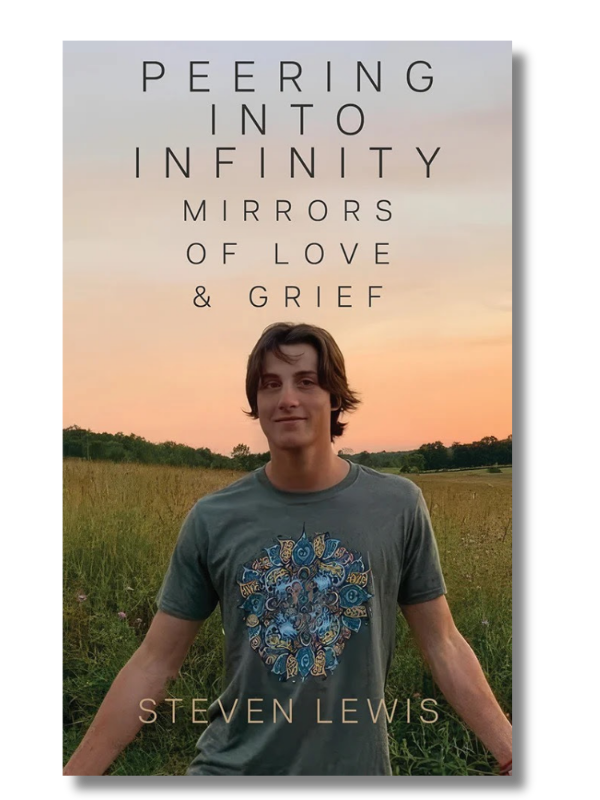
A collection that feels like a held breath, an ache that time does not heal but instead becomes something we learn to walk alongside
“the daily sun and moon of being / a husband, a dad, a grandfather, / all of it seeming to demand a sea wall / of composure against an ocean of hurt”
Peering Into Infinity: Mirrors of Love and Grief is quiet, tense, and aching. Written in the ever-present dull pain of unimaginable grief, Steven Lewis invites readers into an intimate reflection on love, loss, and family. Rooted in lived experience and attuned to the moral and emotional weight of the present moment, the collection is deeply concerned with how we continue to love in a world shaped by violence, absence, and community fracture.
“in stagnant ponds, in the eyes / of people who don’t know I’ve lost my place, / a homeless soul poking through”
The collection emerges in the aftermath of Lewis’s grandson Rory’s death, killed at twenty-one by a drunk driver, and the poems read as part elegy, part witness, part hard-won affirmation. Without revealing specific moments, the book traces a two-year journey of mourning in which the poet moves through public spaces and private reckonings alike: encounters with strangers, memories that surface unannounced, reflections on belief, injustice, and the quiet cruelty of systems that harm while pretending to protect. Here, grief resists language and presses against time itself, forcing the speaker to reckon with how to remain human even when meaning feels eroded.
“barbed / wire grimace crossing his face as he points / the rifle behind at the line of idling cars”
Each poem in this collection feels carefully weighted, as though every syllable has been tested for necessity. Many pieces begin with epigraphs drawn from writers, philosophers, musicians, and cultural texts, creating a rich web of literary conversation.
Others allude to these figures indirectly such as the poems “A Remastered Ride on Patti Smith’s M Train” and “Leaving My Copy of A Coney Island of the Mind at a Bus Stop,” grounding the poems in a shared cultural memory. While each poem begins with an allusion, they all end with a notation of date and city, presumably marking when and where the poem was drafted. This is a beautiful touch that suggests that everything we encounter in life acts as a mirror that returns us to ourselves. I was moved to tears by moments when instead of quoting a famous writer, Lewis turns to the intimate and personal like with his daughter’s social media post in “Meadow Song,” or the Coda’s quotation from a Chinese fortune found in Rory’s wallet.
“We will know the tank is still there / after that fence is up, that nothing is hidden / enough in this life behind walls, will, work”
This journey of a grandfather reckoning with the loss of his grandson culminates in an ending that reveals a detail once perhaps insignificant, yet now most sacred. This revelation brought me back to thoughts of my own son, my family, my minute-by-minute existence, and ultimately back to myself. This collection affirms what must be done: we must write or risk being undone by our circumstances. What the book does exceptionally well is recognize the power of restraint. Lewis never overreaches emotionally; instead, he trusts the break of a line and a well crafted image to carry the weight of loss.
“a place where there is no time, / no beginning, no end, that lonely place beyond / language where yesterday is today is already / tomorrow”
Peering Into Infinity is a book about learning how to say yes to life again without denying pain. Readers should be aware that the collection engages with themes of death, grief, violence, and social injustice. In its brevity, the collection reminds readers that attention itself is a form of love and that how we look at the world after loss matters. This is a book for those willing to slow down and to be gently, irrevocably returned to themselves.




What did you think?