

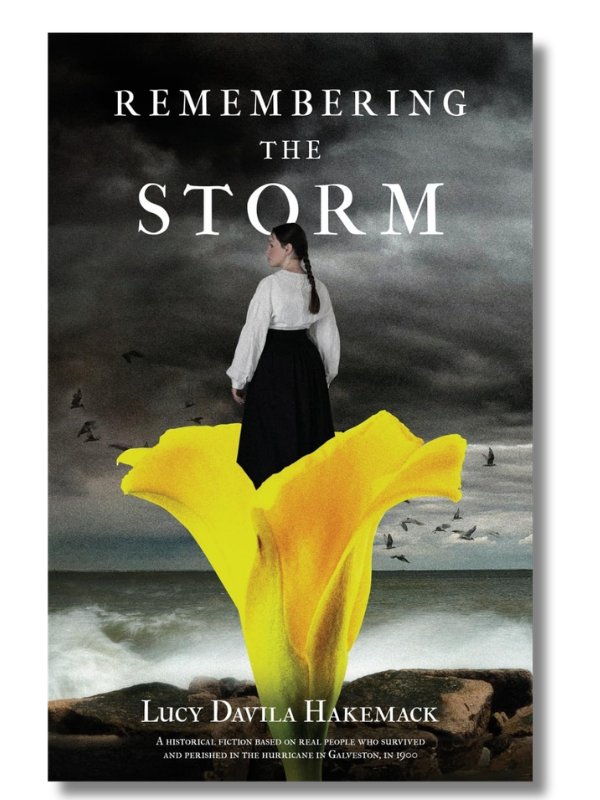
A harrowing account of the devastating, real-life hurricane that hit Galveston in 1900
When Remembering the Storm begins, Ellie is nearing her 95th birthday. As a retired life-long school teacher, Ellie spends her days meeting up with her friends for lunch, volunteering at the local library, and attending the Galveston Historical Foundation meetings to advocate for memorials for people of color and women who were significant in town.
After Ellie receives a letter from the Galveston News asking to interview her for a special edition commemorating the survivors of the 1900 hurricane that decimated Galveston, Ellie is thrust back 75 years in time to relive that fateful event.
Now, in a flashback, Ellie is nineteen years old, returning home after graduating from a teacher’s college in Texas. On the train ride home, she meets Corporal Jim Malloy, a newly stationed soldier and aspiring meteorologist heading to Galveston’s Fort San Jacinto. The two immediately hit it off, and Ellie devises plans to meet Jim again, inviting him to her welcome home party and offering to show him around town.
Ellie and Jim soon fall in love, promising themselves to each other despite their speedy courtship and the fact that female teachers are not allowed to be married. But before the school year even begins and before Jim can talk to her father about their marriage, a large storm leaving Cuba—one that the weathermen in town assured everyone was heading elsewhere—hits Galveston head on, forcing everyone in the community into survival mode.
When the storm hits, Jim stays behind to protect the fort so the other soldiers can try to get to higher ground. Meanwhile, Ellie attempts to get her parents to safety despite injuries they both suffer after being hit by flying debris.
Ellie, as the main character, is a headstrong, at times naive girl with strong opinions about equality that she won’t hesitate to share with anyone and everyone. It earns her more than one sticky situation or social tension, though Ellie doesn’t seem to care. The hurricane storyline not only adds danger to the story but also serves to expose how racism and bureaucracy prevented the residents of Galveston from being warned about the impending hurricane.
Ellie and Jim meet with the Cline brothers, the island’s weathermen, who reveal they must run everything by a man in Washington D.C. before acting, including flying hurricane flags or sending out warnings. There are also many references in the book to the way the weathermen in Washington D.C. cut off contact with those in Cuba due to racism, despite, according to Jim, their being better weathermen. These inequalities and many others, like Black men being forced to be part of the body clean up after the storm or the inability of one of Ellie’s friends to attend the same teacher’s college, are all highlighted because it’s so important to Ellie and her point of view.
The novel does temporarily change points of view, including Jim’s, Julia’s, and other residents of Galveston. It even jumps into the storm’s point of view at times. Since the story is framed around it being a flashback into Ellie’s memories, it would have made more sense to keep everything from her point of view entirely. However, since the author is trying to shine light on the stories of those who experienced the hurricane, changing points of view allows for insight into different people’s experiences during the storm.
Ellie isn’t a very emotional character, nor does she often offer sympathy or warmth to those around her. Only days after the hurricane hits, Ellie goes out into the destruction to confront one of the Cline brothers even though his pregnant wife is still missing and presumed dead and practically lays blame on him and his brother for the horrible decimation of their town. While she sees great horrors, including hearing people calling for help and seeing men rounding up the bodies of those who died to burn on the beach, it’s like she’s more documenting what she’s seeing than really experiencing it. Ellie also ends up being the one to find the bodies of Julia’s parents. While she’s a good friend to Julia, helping her heal from an injury and offering support in other ways, she’s blunt and unemotional in telling of her parents’ fate. Her distance can make her account of the hurricane feel like it’s missing the depth that more emotion could add. She’s said to be sad or upset or proud of herself at times, but we rarely see it on the page.
The writing style mirrors Ellie’s point of view with a matter-of-fact approach to the prose. There are large blocks of text, some paragraphs taking up entire pages or most of a page, that give the narrative a slower pace. The same thing happens with dialogue sometimes. Instead of having characters share news with actual dialogue, what they say is revealed in prose paragraphs, which adds to the feeling that everything is told rather than shown.
Remembering the Storm has a clear message. It’s to tell the story of the Galveston hurricane of 1900 and the people who experienced it. The research required into a retelling like this is evident and impressive. The gravity of the event is well-rendered and objectively powerful. This is a novel that will appeal to those interested in the impacts of natural disasters on American history—with a little bit of young love thrown in for good measure.



What did you think?