

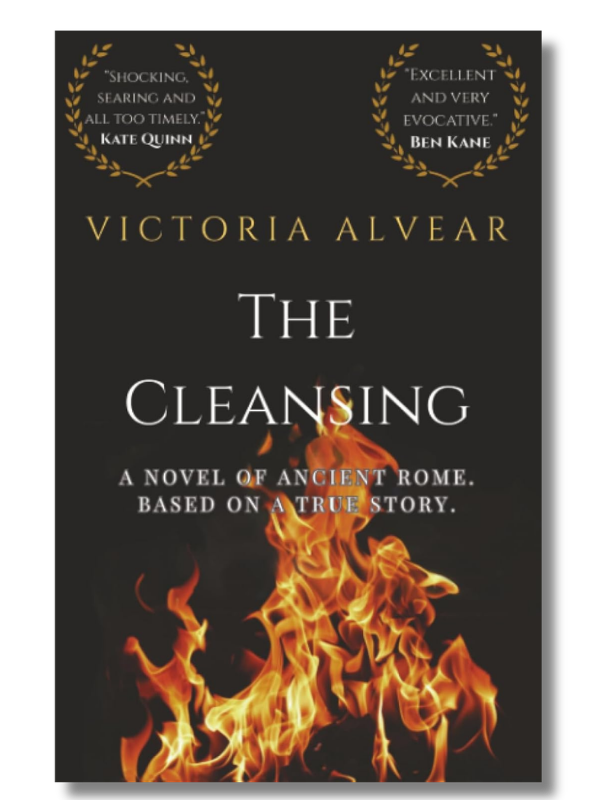
A treatise on the nature and limits of women’s power in a patriarchal culture and the necessity of imagining a true emancipation
Hannibal ante portas—Hannibal is at the gates. In autumn of 216 BCE, the Roman Republic is gripped by existential crisis following a disastrous defeat at Cannae at the hands of the Carthaginian general. The inexplicable defeat seems like a sign that the gods are displeased with Rome, and both military and religious leaders are looking for a scapegoat to shoulder the blame.
Opimia, a distraught young priestess of Vesta, is mourning the loss of her childhood friend Attius, who joined the legions and perished at Cannae. However, the turmoil caused by the military catastrophe threatens to invade the sacred hearth of her goddess’s temple. Rome is aching for an appropriate sacrifice, one to take on the weight of the city’s sins, through which it can purify itself of the taint of defeat. And what sacrifice is more perfect than a virgin priestess?
Victoria Alvear’s The Cleansing is a powerful thesis on the history of patriarchal oppression and the ways it can be resisted. The overall attention to detail in the portrayal of Rome—from its religious festivals, to food and clothes, to sexual mores—is laudable, especially as the novel brings to light an often overlooked historical setting. With mythological Greek figures and gladiatorial spectacles of Imperial Rome enjoying far greater popularity in fictional accounts, a glimpse into the Republican period is a welcome breath of fresh air. All the more so when the thematic focus rests not on military events or power-schemes in palace halls but rather on the cultural values underpinning power—and how those values shape and constrain the lives of women.
The central statement about continuities in gendered oppression, and particularly their enactment through religion, is the novel’s strongest point. Alvear confronts the limitations of power granted to Vestal Virgins and similar priestesses of classical antiquity, demonstrating how this power was embedded in a wider, deeply patriarchal culture.
The novel also rightly points out the subordinate position of Vestal priesthood to male superiors such as the Pontifex Maximus and the broader marginalization of female deities and priestly orders in favor of male ones in the Republican period. It exposes the instability of Vestal privilege and power, which was routinely suspended in times of threat and disaster, with accusations of sexual indiscretion used to create compelling scapegoats for all of Rome’s woes. If the flesh of the Vestal virgins was the flesh of Rome itself, then any failings of Rome could easily be ascribed to a failure on the priestess’s part, cursing the city.
The problem arises, however, with not fully engaging in the religious beliefs and attitudes of the historical cultures. Characters are either very modern in their religious outlooks (like the atheist soldier Attius), completely cynical about their faith (like the Pontifex Maximus), or their religious convictions go only as deep as the abuse of authority figures who instilled them, as is the case of the protagonist Opimia. The latter does not quite lose her faith—merely supplants one worldview with another, more intuitive one—but the fragility of her convictions and the awareness with which she reflects on her religious upbringing mean that the novel lacks a major character who actually sincerely believes in the religion that is depicted. An ahistorical element of the book is the invocation of a primordial Mother Goddess; a concept with shaky scientific foundations despite its popularization by the likes of Marija Gimbutas in the mid-20th century.
In spite of these liberties taken for the sake of driving home the thematic thesis, Victoria Alvear sticks the landing beautifully. Any inaccuracies should not be taken as signs of ignorance but as a matter of artistic license. The Cleansing builds on the documented and attested, and imaginatively builds through a “what-if?” to craft a powerful critique of both the past and the present.
The ancient city of Rome is brought to life through attention to detail and great care. Cultural webs in which the political players are suspended are likewise vividly crafted.
Finally, through a conflicted yet spirited main character of Opimia the reader is given to understand not only the culture of the ancient city, but the ways in which women embraced it, negotiated it, or outright rebelled against it. And while Opimia’s crisis of faith is painted in fairly modern colors, it is because the historical incident that threatened her life is all too pertinent for us today.



What did you think?