

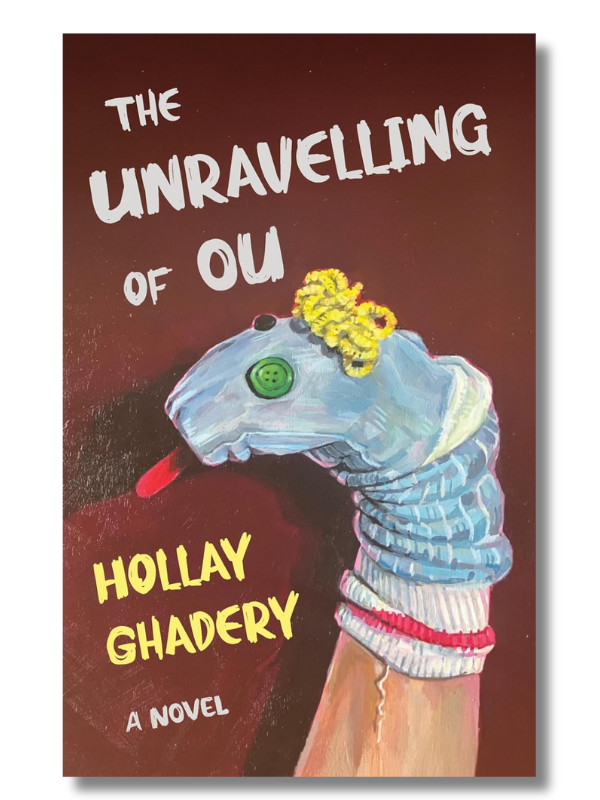
Unflinching and emotionally immersive, The Unraveling of Ou traces the fragile threads of womanhood, suffering, and strength as they strain but never break.
Told from the perspective of a sock puppet, Hollay Ghadery’s The Unraveling of Ou, at first glance, seems to invite whimsy. Ecology Paul, a gray sock with mismatched eyes, a felt tongue, and yellow pipe-cleaner curls, lives on the right hand of Minoo, a middle-aged Iranian woman who was exiled from Tehran as a teenager and now lives in Ontario. Yet what unfolds is not a playful conceit but a deeply serious, emotionally precise exploration of trauma, motherhood, and the ways women learn to endure. By giving voice to a sock puppet, The Unraveling of Ou reveals a perspective on womanhood and inherited trauma that is tender, startling, and rarely heard.
The novel begins on what is meant to be a joyful day for Minoo: the arrival of her granddaughter. Instead, the moment is charged with anxiety. Minoo’s daughter, Roya, has drawn a firm boundary. Ecology Paul cannot be part of her child’s life. Minoo must choose between her constant companion and her already-fragile relationship with her daughter, possibly even with her granddaughter. From this present-day rupture, Ecology Paul begins to narrate how Minoo arrived here, tracing decades of displacement, silence, and love shaped by condition.
As the narrator recounts Minoo’s life, the novel moves between Iran and Canada, childhood and adulthood, intimacy and estrangement. We learn of Minoo’s early pregnancy at fourteen, her family’s response rooted in fear, shame, and control, and her departure from Tehran to protect her reputation.
In Canada, she lives with her cousin Cala, whose unconditional affection contrasts with her past experiences. Cala offers what Minoo rarely knew: “Someone with whom affection was unpracticed and love itself didn’t need to be earned to be shown.” Throughout these memories, Ecology Paul acts as a witness and shield, speaking when Minoo cannot, smoothing social interactions, and absorbing her fear. He is aware that his role may now be limiting her. “I am here so that life does not stop for Minoo,” he explains, “That’s all.”
One of the novel’s most powerful aspects is that it rejects the idea that survival must end in triumph, suggesting instead that it’s about identity shaped by life’s struggles. It presents women who are wounded yet capable, loving yet harmful, enduring yet exhausted. The Unraveling of Ou offers recognition over comfort: Roya’s anger stems from longing for a fully present mother who speaks her truth and prioritizes her daughter. What makes it so impactful is its unfamiliarity, not inaccessibility, but in telling a rarely-centered story. It invites sympathy in multiple directions, showing harm passing through generations instead of resting with one character. Nearly every woman bears trauma from family, culture, or expectation, but none are weak. They are strong in painfully human ways: improvisational, inconsistent, born of necessity. What begins as an unexpected narrative choice becomes a fresh, emotionally exact lens on survival, silence, and the ways women learn to endure.
Ghadery’s portrayal of inherited trauma is vivid. Minoo’s memories of her mother fade as she ages, affection recedes, and her body is policed. “Roses are so beautiful,” the novel echoes, “but they also know how to protect themselves,” a metaphor for women hardening to survive. Ecology Paul’s narrative voice effectively explores dependency without sensationalism, intimate yet estranged, empathetic yet aware of its limits. The novel resists easy catharsis, offering a quieter truth: “Maybe yours isn’t a story of the ‘things that don’t kill you but make you stronger.’ Maybe it’s just a story of the things that make you who you are.”
Inventive and tender, Ghadery’s novel lingers, asking what it means to risk being held by real hands again, even when terrifying. It recognizes how difficult moving on can be, especially when what you leave behind once kept you alive. Ecology Paul is a character I will not get out of my head for quite some time.


What did you think?