

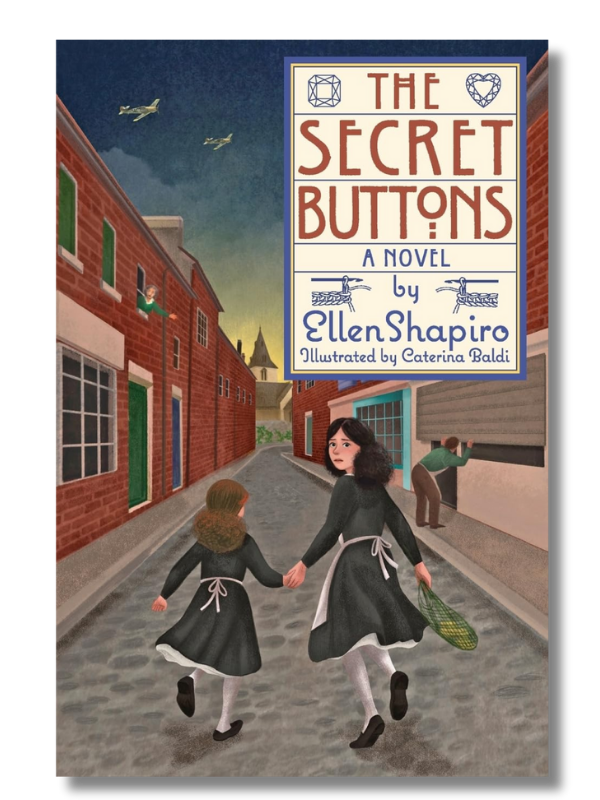
Brimming with heart and heartache—enriched historical fiction that stands tall among middle grade giants
Ellen Shapiro’s The Secret Buttons begins like the opening pages of The Lion, The Witch, and the Wardrobe: A mother sends her children off by train to escape the threat and horrors of World War Two.
Unlike C.S. Lewis’s Pevensie siblings, though, this book’s protagonists aren’t headed for enchanted worlds and epic adventures. Instead, the Jewish sisters, Annegret and Rosie Blum, are escaping the tightening fists of Nazi-occupied Austria. As they reach the relative safety of England, they begin to come of age facing the plights of the refugee, from the alien nature of unfamiliar surroundings to trials of learning English and holding their own in a community that sometimes makes it all too apparent that they are Others.
The Secret Buttons feels almost too real and lived-in to be fiction, and readers will ache with the hope, fear, and tender courage of its heroines.
Not as sweeping or operatic as something like The Book Thief, this book’s greatness comes from its slice-of-life pacing and simple prose. Readers follow along solely from Annegret’s perspective, and though she never explicitly states her feelings, her emotions are clear in every slight and heartbreak she finds herself navigating. When running to a skating rink, for example, eager to show off the sweater she knitted herself, she arrives and thinks, “Oh! What happened? The gate was locked. There was a guard and a new sign. In big, bold letters it said FORBIDDEN TO JEWS. Through the fence I could see other children skating and hear their shouts and laughter. Of course. They were the ones who joined the Aryan Youth League.”
Whether Annegret is describing the skating rink or how the neighbors bribe Nazis with paintings so they can keep living in their homes, or even the way she and her friends create spaces to play to replace those they aren’t allowed in anymore, the keen sense of unfairness that a child can feel is clear. Someone Annegret’s age may not have the words for it, but she knows that piece by piece, her life is being stolen.
My favorite historical fiction is true, not just in the sense of factual accuracy, but in its perception of what its characters face. The Secret Buttons does that in spades, recognizing that for refugees, escape isn’t the end of your problems—in fact, the problems you’re running from threaten to follow you wherever you go.
While Annegret and Rosie escape the immediate danger of Austria, the Nazis continue to be a threat, looming over their resettlement with their English uncle and his family. The moment they arrive at their uncle Benjamin’s cottage, their cousin Ronald tells them, “My friends and I must something-something the somethings” (Annegret’s limited English doesn’t let her understand that Ronald is blacking out signs so the Nazis don’t bomb them or know where they’re going if they invade). As she and her sister become more acclimated, she finds herself coming up with fashion-forward versions of blackout drapes to prepare the cottage for the blitzkrieg.
One standout examples of this is when Annegret, Rosie, Ronald, and his friends are assembling the Ashers’ bomb shelter in the backyard from a kit. To keep their skirts from getting dirty, the two girls wear the suits meant for sitting in the shelter should German bombs strike. As they work and play together, however, Ronald’s friends question why the girls have come. “She sounds like a German, a Nazi!” They shout and begin teasing the sisters, calling them Nazis and spies. While Annegret fiercely defends her sister, the subtext is plain: not only have the Nazis stolen their country, they may have robbed these innocents of their ability to be safe and welcome anywhere.
The Secret Buttons wraps such powerful insights in children’s tender experiences and tempers their somber wisdom with tenacity and joy. Accompanied by Caterina Baldi’s charming illustrations, this book is a must-read for young history enthusiasts studying World War II.




What did you think?