

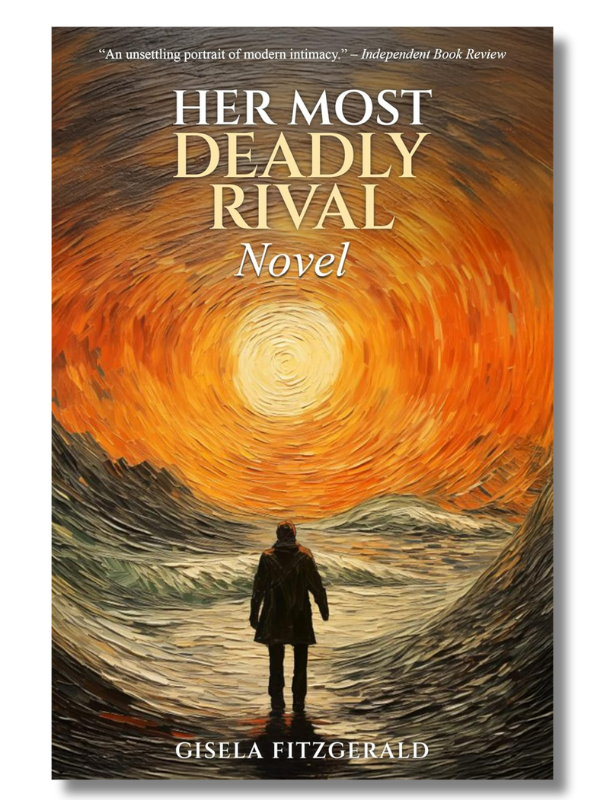
An unsettling portrait of modern intimacy
A meditation on infatuation and the complex power dynamics that characterize contemporary relationships, Gisela Fitzgerald’s Her Most Deadly Rival explores the thorny process of regaining identity and agency in the domestic sphere as chaos reigns in the wider world. Will it prove too much for even a self-described Queen Bee?
The conflict begins, innocuously enough, with a party: an artists’ gathering in a refurbished abbey, where intellect, desire, performance, and self-deception ferment. Fitzgerald quickly establishes the centrality of obsession: how it forms, how it masquerades as love, and how it corrodes clear thinking.
Adam Monroe is a literature professor whose cultivated life (lectures on James Joyce, aesthetic opinions, and emotional restraint) begins to unravel the moment he sees Regina Marcel, a flamenco dancer and scientist researching honeybees, at the party. Adam is there with Emily Hamilton, his long-term girlfriend, who reasonably expects a marriage proposal.
Instead, Adam experiences what he immediately frames as inevitability rather than choice. As he watches Regina dance, the sight of her “sparked shockwaves that alternately sickened and healed him, blinded and enlightened, struck him deaf and made him hear again.” From this moment on, events are propelled by fixation rather than action.
Adam is emotionally entangled with Emily, intellectually and erotically obsessed with Regina, and constitutionally incapable of honesty with either the women or himself. This situation leads to both a love triangle and a study of rivalry—between women, yes, but more profoundly, between fantasy and responsibility.
Regina initially emerges as the winner. “The break with Emily had already occurred in his mind but not heart.” However, victory proves fleeting and Regina starts to see echoes of relations in the hive in her own life. Armed with the knowledge of nature, can she secure her place and avoid being ousted from her position?
While Regina is the Queen Bee, Adam positions himself as the central figure. He is articulate, self-aware in theory, and endlessly capable of literary analogy, yet he is spectacularly blind to his own moral evasions. When he confesses, “The trouble is I love Emily but not like I love Regina,” it feels more like a courtroom defense than an emotional declaration.
Author Gisela Fitzgerald repeatedly exposes how Adam uses language—especially language borrowed from the literary greats—to dignify impulses he does not want to face. There’s no getting away from the fact that he is pretentious and condescending, but his stubborn avoidance of inner conflict is oddly compelling.
By contrast, Emily Hamilton is presented with deceptive lightness. She dances, decorates, jokes, and talks—often, quite a lot. Adam interprets this as superficiality (“At the moment he would have been happy to throw Emily into Peter’s piranha tank.”), but Fitzgerald slowly reframes Emily as emotionally authentic, unlike the others.
Her repeated insistence on kindness and sufficiency—“You are enough”—stands in quiet opposition to Adam’s hunger for transcendence. Emily understands love as presence, whereas Adam understands it as escape. On that basis, she seeks partnership while he is arguably after completion.
Regina Marcel, the eponymous rival, is neither seductress nor villain. She is cool, competent, ironic, and deeply committed to her work with bees. Fitzgerald’s detailed descriptions of Regina’s laboratory, particularly the artificial insemination of queen bees, are enlightening but strangely unsettling.
When Regina explains that drones die in the act of reproduction, the metaphor is unmistakable. Desire is not gentle. It is efficient, necessary, and often lethal. Adam senses that she is not performing intimacy for him, and it terrifies him. His fear crystallizes in a telling thought: she is “weaving his destiny with the dainty movements of her fingers.”
Aside from apiology, literature functions as both scaffold and mirror throughout Her Most Deadly Rival. Adam teaches Joyce, Goethe, and Stein but fails to live up to the ethical demands of the works he reveres. His invocation of Joyce’s Ulysses is hollow when viewed in light of his refusal to commit honestly to Emily.
The novel’s political commentary, which is woven into casual conversations and metaphors, reinforces its larger themes of power and abdication. Characters debate authoritarianism, moral cowardice, and institutional collapse, often using language that echoes Adam’s personal evasions.
Events unfold during the second Trump administration, which colors almost every aspect. The private and the public mirror each other: obsession thrives where accountability is avoided. Not even the bees are safe: “Trump sent his chainsaw hacker to kill the branch of our Department of Agriculture that runs the honey bee labs.”
Given the intrusion of politicized reality into the story, the narrative frequently slips into essayistic reflection, particularly when Adam’s thoughts take center stage. At times, this approach slows the pace of the story, particularly the dialogue, but it also feels true to the characters.
Adam’s inability to stop thinking, analogizing, and justifying reflects his inability to act with clarity. He admits in a rare moment of self-awareness that he has entered “Regina time,” a private chronology where ordinary obligations no longer apply. But can Regina leverage this power for her own ends?
Ultimately, Her Most Deadly Rival neither punishes desire nor sanctifies fidelity. Fitzgerald offers a sharp examination of romantic intimacy, one in which obsession is disguised as culture and love is often confused with intensity. The characters—save for the bees—might be unappealing, but they are also deeply recognizable.


What did you think?