

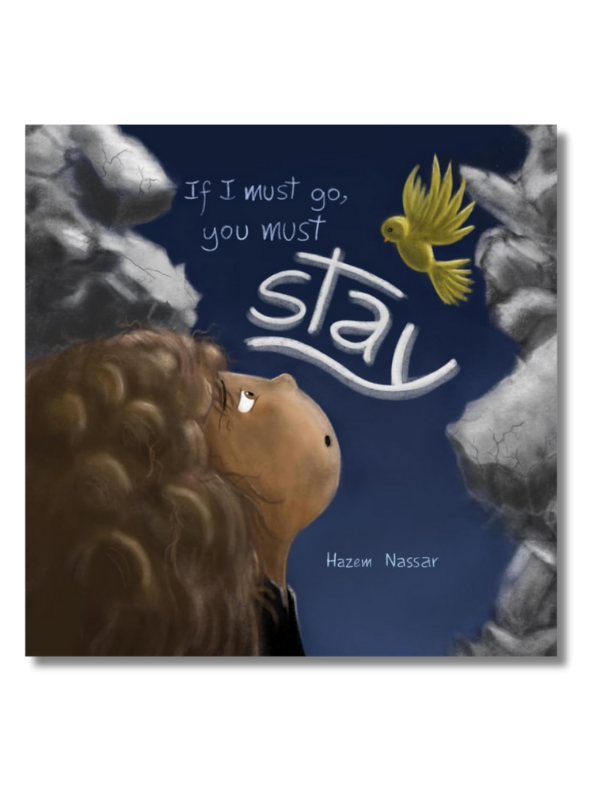
A heartbreaking story of loss in a war-torn landscape
Salma finds herself alone under the rubble. She’s calling out for her family but is receiving no response. Set against a dark backdrop, the opening of If I Must Go, You Must Stay mirrors the heaviness and fear Salma must be feeling. Loss is lingering in the air, and readers can feel it.
But soon enough, her brother Ahmad calls back. A small yellow bird finds her in the rubble, and he’s carrying Ahmad’s voice. He tells Salma that he and the rest of her family are on their way “up.”
“Where are your wings, Salma?”
Butit isn’t Salma’s time. She’s given a tearjerking moment to say goodbye, but she can’t quite say it. It’s special that she gets this magical going away moment, as not every child in these harrowing circumstances is given the chance. It’s a sort of dream sequence, an unbelievably sad but meaningful dream.
“If I must go, you must stay. To tell my story, come what may.”
After Ahmad flies away, Salma gives herself time and space to cry, and she suddenly finds herself much lighter. Levitating. Rising out of the rubble. But she does it without wings, ready to begin again.
If I Must Go, You Must Stay by Hazem Nassar is about as emotional as kids’ books get. This is a good conversation piece to share with your little one about loss—the biggest loss, of losing your whole family—and of war. Nassar doesn’t utter the word “death” but doesn’t have to. It’s clear the family is gone and Salma is left here alone. If your little one is ready to broach a topic such as this, whether because of their experiences or because of their growing curiosity about what other kids have to go through, this book is an artful rendering told with a big, heavy heart. It’s about how trauma and tragedy shape people and how your roots will always be in the ground no matter where you go from there.
In addition to telling this thoughtful, painful story, Nassar illustrates the book, and the illustrations are quite powerful. Not only is the emotion apparent in the subtleties of sweet little Salma’s face and eyes, but the color contrasts in emotionally resonant ways. The representation of Ahmad, a small yellow songbird, contrasts with the darkness surrounding Salma in the rubble, and the darkness is ever-present in the saddest of Salma’s moments. Sometimes the page is only black, and his voice is the only thing peeking through the darkness.
It is an emotionally heavy story with content that you will want to be aware of before reading it aloud to your small child, aimed likely between ages four and six. It’s inevitable to stop mid-read to discuss death, war, and the unfairness of life with your young one. The ending approaches and leaves without much transition, but the concept still lands. Tackle this one only if you and your child are ready for a cry.
But if you are ready, it’s done tastefully and with the promise of a new beginning. Nassar adeptly illustrates how life can go on after unspeakable loss as long as we hold tight to where we come from and share the story of those we’ve left behind.


What did you think?