

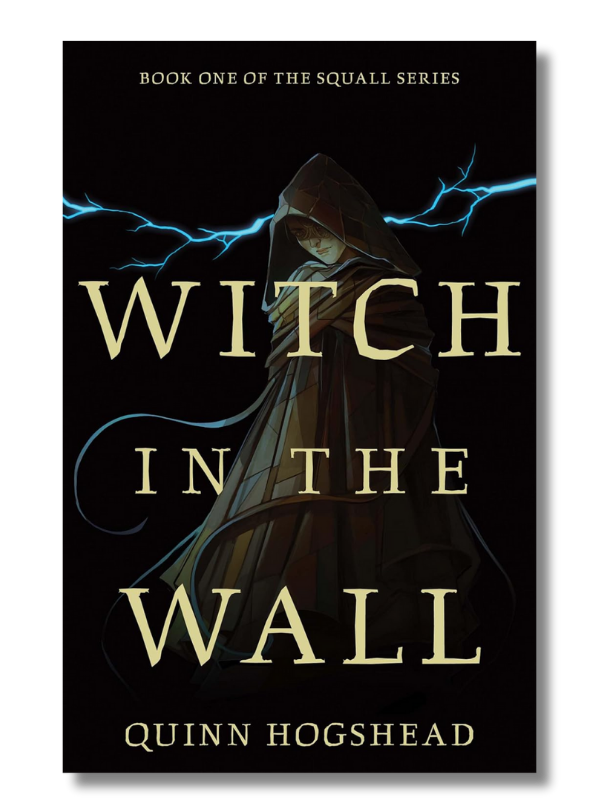
Succession meets The Magicians in this gorgeously gruesome, murderous battle for the throne.
Quinn Hogshead’s Witch in the Wall is drenched in the shared emotional experiences that make sibling rivalries so searingly painful. From savage start to shocking, star-crossed ending, this bloodstained battle for succession has a bodycount so dizzyingly high that you’ll get whiplash from how deadly the ascension to the throne becomes.
Here, we meet Gavriel, the bastard child of his royal family, when he’s summoned to the announcement of his father’s death. Their world is ruled by fae who use magic to keep people terrified and obedient, with a human royal family installed for all situations beneath fae emperors.
With Gavriel’s father—their king—dead, the royal court must crown one of his children. This should be a simple process, his older brother already in line to ascend, but witches with hidden agendas suddenly threaten the court, disrupting his ascension and putting the entire kingdom in danger. Court drama leads to magic-powered coups and armies taking sides.
Sparks fly between Gavriel’s siblings, who were raised with different ideas about inherited power, delivering speeches that could be straight out of Shiv, Roman, or Kendall’s mouths, the long-held bitterness of waiting in the wings suddenly rising like bile in their throats. Once united on the side of the expected king, Gavriel’s siblings are suddenly seduced by the idea of their own rule.
If you enjoy stories about a family gathering for the reading of a will, during which they learn that the patriarch did not bequeath his entire estate to the older son who trained for this all his life, prompting the family to spiral into unprecedented chaos, this book is for you. That’s not what happens here, but Gavriel’s family learning they can vote for any sibling to rule has that same frantic, clawing-at-each-other (sometimes literally! One very bloody scene sees magical, murderous beasts unleashed on the castle in an attempt to swing votes!) desperation that you’ll love.
Richly woven with grief and guilt and gore, I was enthralled by Witch in the Wall’s descriptions of dark magical battles and miserable immortal beings. It opens with heart-wrenching family histories, tense sibling dynamics, elaborate death rituals, and a sense of impending doom that covers their homeland like a fog. We are introduced to this reality through gorgeous prose that makes reading feel like devouring. Author Quinn Hogshead writes everyday magic like light traveling through a room at sunset with the same stunning quality as the dazzling detail in scenes of rotting corpses walking amongst the living.
“Either this was a dream, I was crazy, or I’d done something unforgivable. I wasn’t exactly sure which of those options I wanted to be true.” While grieving and trying to understand the strategy behind the courts preventing his brother from becoming king, Gavriel is caught up in a personal tragedy: After an unexpectedly satisfying sexual experience with his best friend (and his brother’s bodyguard!) Aziz, things between them are immediately awkward. They had planned to meet later that night to run away together, but Aziz never shows up. Crushed, mortified, and desperate to not ruin the friendship, in that moment Gavriel would do anything to make things right. Enter: An ancient magical entity who promises Gavriel the world (and the man he loves!) if he agrees to be possessed.
“You want to see the ocean, Gavriel? I can show you all of them.” He ran a finger across my lip. Aziz is the perfect love interest for readers who love a hot assassin, a bodyguard romance, or the best-friends-to-lovers trope. Aziz, who calls Gavriel “sweetheart” and tells elaborate, ridiculous jokes to cheer him up, is Gavriel’s perfect love interest for reasons that keep revealing themselves throughout this novel. Royal scribe Gavriel includes details about how handsome his brother’s bodyguard is in the court’s official history books. Aziz is a knight trained to protect innocent people from witches, whose best friend was now secretly possessed by a witch. Gavriel agreeing to possession was a downright idiotic, potentially catastrophic, frankly unjustifiable, universe-imploding impulse decision. But a powerful star-crossed lover energy sparkles across the skies of destiny between these young men.
“There was someone else inside of me. Where I was terrified, he was confident. Where he was nihilistic, I was naïve. Where he was scorned, I was kind. Together, we voyaged into the eye of the storm.” What begins as a battle for power ends as a battle for existence, for the striking ability to hold up the stars in the sky and decide whether to repeat the history of the universe. There is so much more to this world, Gavriel learns. So many types of magic, and so many methods of betrayal, and yet Witch in the Wall never feels dense or overwhelming. It’s an absolute joy to read. These pages are filled with emotionally-charged training montages, where Gavriel must fly through decades of spellcasting-while-possessed lessons to save his homeland before it’s obliterated by dueling witches.
The intimate, volatile push and push-back between inextricable possessor and possessed reminded me of K. Ancrum’s The Corruption of Hollis Brown. If you loved the trickster energy and ever-changing demands of The Magicians’ season when Fillory is ruled by Queen Margo but secretly occupied and tormented by the fairies, you’ll love this book. Gavriel’s every problem-solving attempt is an introduction to a different law from the ruling fae and a deeper hole that his siblings were drawn into; the tragicomedy of the situation constantly revealing itself as something else.
Witch in the Wall explores power: those who want it, those who don’t; the way desiring power can change who you are; and the inescapable corruption when power is thrust upon those who want nothing to do with it. The novel is drenched in soured power dynamics and soul-tied history. Even the evil witches have daddy issues! The spirit who claims souls and strikes fear in Gavriel’s hometown builds surprising alliances and spills ancient secrets because of drama with his dad.
Quinn Hogshead expertly conveys the intricacies of interpersonal drama, particularly between siblings. The hidden history each child holds in their heart spills out at the most hurtful moment and ruins everything: “My heart shattered along the well-worn fault lines.” Gavriel must untangle unfathomable layers of grief while plotting the best route to save the royal family from collapse, save the kingdom from the royal family, and save his siblings from themselves: “I felt nothing toward the cold, brash shell of a man who’d bled out on a cold stone floor. But the boy who taught me to ride through the glen around the summer estate? I missed him. Terribly.”
I loved that queerness is so casually and so completely present in the story. It’s in the bright humor, the horniest scenes, and in the secret history that has unknowingly torn their universe apart. This book has so many perspectives and slivers of ancient memories appearing in the middle of a present-day scene, and queer yearning is at the heart of it, in every timeline, perspective, and training montage. The witches hide secrets from the humans they possess even though they share a mind and a spirit, but readers are never once confused about what is going on, who is speaking, or what each character knows. We are deeply invested in it all.
Witch in the Wall’s violence is visceral and integral to the story. A little girl is murdered in a shocking, bloody scene; we frequently flash back to the gruesome night of Gavriel’s dead mother’s reanimation. Readers should be prepared for the sudden death of anyone in this family, from a beloved childhood pet as punishment, to the still-dripping head of a relative being pulled out in court as a powerplay.
Witch in the Wall’s twists and dramatic reveals will have the reader gradually moving closer to the edge of their seats; at times audibly gasping, at others, holding their breath. The reveal I was most looking forward to was incredibly satisfying, cinematic, and so much sexier than I could have imagined. The direction the story followed from there could have easily been a highly anticipated sequel novel in its own right. That said, we need a greater word than ‘cliffhanger’ for the way Witch in the Wall ends. The final sentence stole my breath and shoved me off a cliff just for the thrill of hearing me scream. Readers will gasp more dramatically than they ever have before, and urgently shove this novel into their friends’ hands so that they can scream about it together.





What did you think?