

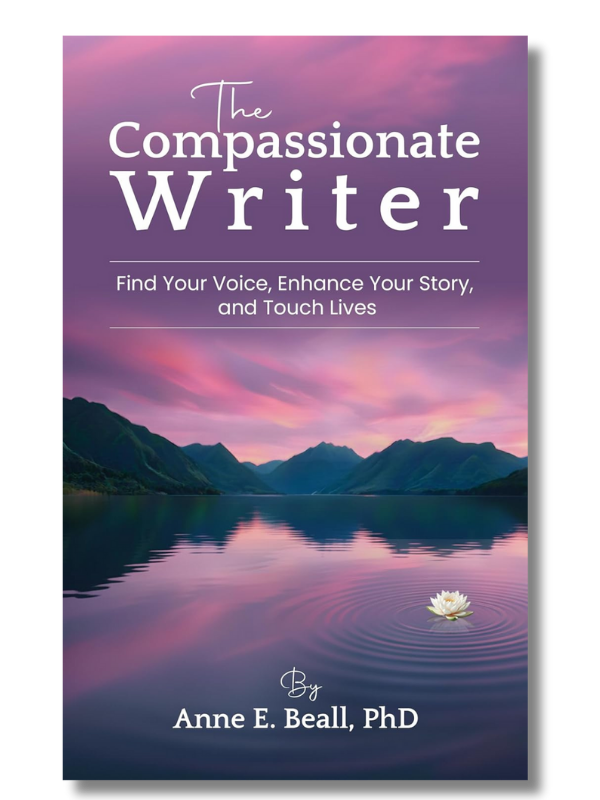
A writing book that makes compassion a craft and agency a practice
“You are worthy of writing your story simply because you exist.”
As a poet grappling with my own nasty inner voice, paralyzing perfectionism, and fear of vulnerability, The Compassionate Writer seemed to arrive at just the right time. Writing is often framed as a solitary act, but for many of us, the real struggle happens in that solitude through doubt, fear, perfectionism, or the emotional weight of telling the truth.
In The Compassionate Writer, social psychologist Dr. Anne E. Beall tackles these often unspoken challenges head-on. This self-help guide for writers presents itself as both an antidote and a call to action, offering a grounded, deeply humanizing framework for navigating the emotional challenges of writing.
“Like the ocean, you hold countless moments and ideas, waiting to be brought forth. Some of them are from poignant moments of your life while others are people, worlds, and events you have imagined.”
Dr. Beall centers her book around addressing the inner obstacles writers frequently face, from the intimidation of the blank page to anxiety about depicting real people or revisiting difficult experiences. She explains why these fears arise through the lens of social psychology, highlighting familiar struggles without pathologizing them. Rather than simply naming the problem, she consistently redirects writers toward actionable solutions. The book moves fluidly between reflection and practice, offering examples, scenarios, and compassionate reframes that help writers understand their emotional responses and move through them with intention.
“Remember, the goal isn’t to silence your inner critic completely, but to reshape its voice into one that motivates, guides, and strengthens you.”
The book’s structure is one of its greatest strengths. Each chapter begins by naming a specific challenge, from self-doubt to vulnerability to legality, then reframes that challenge through compassion. Dr. Beall shows how compassion for ourselves, compassion for the people who inhabit our stories, and compassion for our imagined readers can reshape not only how we write, but how we relate to our own creative process. She then provides a series of tools including reflective exercises, writing prompts, and guided visualizations that draw on meditation practices.
A testament to Dr. Beall’s own creative writing prowess, these visualizations are vivid and sensory, helping writers reconnect with their bodies, their intentions, and the deeper purpose behind their work. When I tried an exercise in Chapter 2, writing my own inner critic as a personified figure with body language, a voice, and motivations, I knew I was reading something special. Through these methods, writers regain agency over the creative process, learning to write on their own time and terms while transforming the inner critic into a mentor who guides rather than shuts down.
“Keep in mind that you get to choose when and how to engage your inner critic. It doesn’t run the show. You do.”
What this book does exceedingly well is strike the perfect balance between psychological insight and practical guidance. Dr. Beall doesn’t simply diagnose the inner barriers that writers encounter, but she helps us understand them, soften them, and work with them. Her approach is gentle yet empowering: fear becomes something we can name and navigate; the inner critic becomes a potential mentor rather than a tyrant; vulnerability becomes a resource for much-needed humanizing texture in a story rather than a threat. Her nods to thinkers such as Jack Kornfield, Brené Brown, and Kristin Neff enrich the text, while her references to writers like Ocean Vuong, Roxane Gay, Maya Angelou, and Anne Lamott ground her advice in real creative experience. Her insights into emotional honesty and the interplay between life and art apply equally well to both memoir and fiction writers.
“Through their writing, they invited readers into the reality of their vulnerability, showing what it feels like to be exposed, uncertain, and profoundly human.”
The Compassionate Writer reminds us that writing is not merely the act of recording events but also the process of making meaning. Dr. Beall’s compassionate framework helps writers honor both their stories and themselves, transforming writing from a battleground into a site of healing and exploration.
This book is an invaluable resource for memoirists, fiction writers, and anyone struggling to approach their creative work with gentleness. Even non-writers will find the exercises and reflections meaningful, as they offer pathways toward greater self-understanding and self-compassion. For anyone who has ever needed reassurance that their story matters and is worthy of being told, this book is yours.




What did you think?