

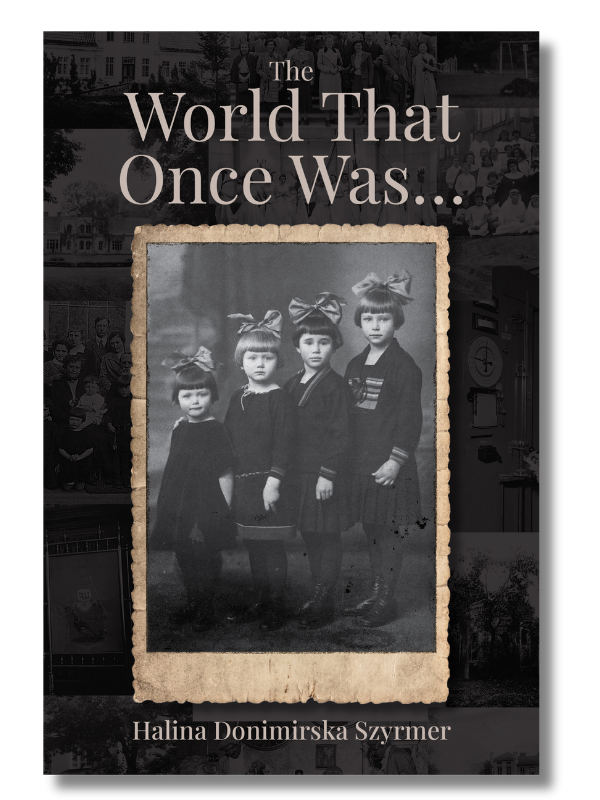
A moving portrait of a patriotic, ethnically Polish family in Germany during the long twentieth century and of a young woman who found herself at the center of WWII’s Warsaw Uprising
“As citizens of the Reich, we were not allowed to take money abroad or have any income there. If there was any, it had to be deposited with the German State Bank”
Going back generations in the East Prussian borderlands, Halina Donimirska Szyrmer’s family maintained their Polish heritage and language even in the midst of German efforts at assimilation in the early twentieth century. Following WWI and the Treaty of Versailles, they threw themselves into the plebiscite that ultimately decided what parts of their land would become Polish and what parts would remain German. The World That Once Was… documents this and many other granular moments that often slip to the wayside in large-scale textbooks.
This memoir recounts historical details—whether of communicating with a mother inside of a concentration camp, coming to terms with a father killed by the Nazis, or working as a nurse and providing aid to both sides of a battle—with the precision and tactile sense of being there that only comes with a first-hand account.
Szyrmer’s story stands out for its uncommon attention to the small moments of life lived during enormous upheaval and the stories of all that happens in the aftermath of a calamity. Not only does it recount the lead-up to WWII and the heat battle, but the quiet reestablishing of lives in its aftermath.
“I explained to them that my father had died in a concentration camp, my mother was still in Ravensbrück, and I had vowed I would not go to the movies until she returned. During the German occupation, going to the cinema was treated as a collaboration with the occupier, who managed the cinema. ‘Only pigs sit in the cinema’ was a common saying.”
This is a history written by and about the ordinary people who do not often write or appear in histories. Simple moments like negotiating family finances during wartime and strategizing how to continue a child’s education come to the forefront.
While this provides a rare glimpse into day to day life, it also results in the accumulation of details that may not appeal to general audiences. Many parts of the text have the hallmarks of a private family archive that will be of interest to relations tracking their heritage or historians trying to understand period background for a detailed monograph. For general audiences, such details can become tedious and humdrum. This is heightened by the prose, which, while direct and forthright, does not make use of storytelling techniques like tension, arc, or pacing. Rather, the writing is informational, assiduously tracking the highs, lows, and other developments in a family.
“A bomb had collapsed the ceiling, which hung diagonally. Beneath it, covered with debris, lay our colleagues amid tongues of flame. All efforts to extract them from there were fruitless. When debris was removed from below – the ceiling slipped, and when attempts were made to reach them from above – bricks and wall crumbs fell on them. And they burned alive.”
Photographs and scans of primary source documents intermix with the text. These play into the book’s strengths, showing family members and capturing beautiful images of a time that was both on the cusp of war and, perhaps because of that, leaning into the bacchanalian pleasures of life. There are gorgeous black and white pictures of dances and other gatherings.
On top of the imagery, the book makes use of timelines and other appendix material to situate these memories and capture a sense of the author’s life beyond her words. In that way, this book offers a full treatment of one woman who survived atrocity, helped others survive, and lived to become the matriarch of a large family.
An assiduous, deeply intimate account of one Polish family’s story before, during, and after WWII, The World That Once Was… is a treasure trove of historical and genealogical information.



What did you think?