

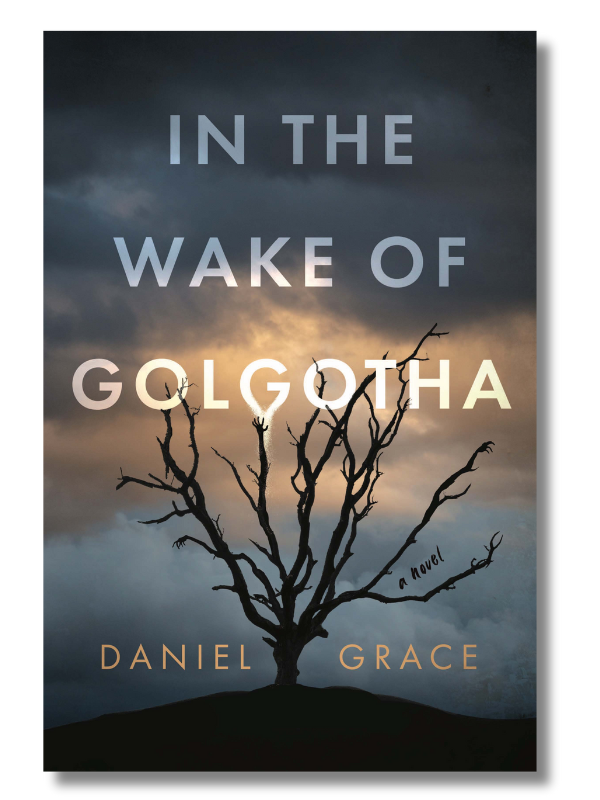
A gripping story following Judas Iscariot and Pontius Pilate in the present day as they struggle with the legacy of their ancient actions
“He had grown numb to such violence, but below him, in the dry courtyard of the King’s Chamber of Hewn Stone, was something very different. This was a man who beat his own soul, and that took a peculiar kind of strength.”
Capturing the tormented moment of Jesus’s betrayal and crucifixion in a vivid prologue, In the Wake of Golgotha imagines Judas Iscariot and Pontius Pilate as timeless figures doomed to millennia of reincarnation and suffering.
Judas, having wandered through the crusades and the great wars of the twentieth century, is now a miserable social worker and adjunct literature professor in Manhattan named Jude. Well aware of his past trespasses, he obsesses over hangings and autoerotic asphyxiation and takes shelter by teaching the great works of literature.
Pontius Pilate is a righteous criminal defense lawyer named Peter Pheiffer who, though unaware of his history, is drawn to cases involving capital punishment. Their paths collide once again when Balthazar Bedrossian, a MRI technician deranged by a malevolent force, crucifies three innocents in his Chinatown basement apartment and intentionally turns himself in to Peter.
“One hundred and sixty-seven restless, haunting nights had crept by since Peter Pheiffer opened a hand-delivered envelope that contained three Polaroid pictures, with the signature of a man named Balthazar Bedrossian and his house-of-horrors address scribbled in blood on the back. Three naked men appeared to be crudely nailed to a wall.”
Balthazar’s crucifixions act like a magnetic force that reopen the violence that haunts both Peter and Jude. The book stages this fateful wrong convincingly within the bounds of psychological realism, showing all three characters wading through childhood trauma. Balthazar was homeschooled in the cult-like environment of his mother until she died and he went into foster care. Peter and Jude both lost parents young. These youthful traumas resonate in different directions, showing psyches and consciences warped by pain. This attention to psychological realism allows the book’s most vicious criminals to appear human, worthy of compassion. Yet at the same time, culpability and the basic requirements of right and wrong are not ignored. This moral conflict that must choose sides is beautifully staged in Peter’s attempt to defend the unapologetically murderous Balthazar in court.
“‘If you could look death in the face, would you blink?’ the man with gentle but heavy eyes asked.
Without thinking, Peter replied, ‘Yes, out of respect…. There was a time I may have even winked.’”
The book’s chapters shift focus between Jude, Peter, and Balthazar. By alternating in this way, each character’s inner life and arc is fully embodied on the page. Still, the inclusion of Balthazar within this triumvirate has an unbalancing effect since his perspective is far less present than the others. In addition, leaps back into the past, moments that intertwine biblical time with present moments, and a lengthy period in which Jude’s and Peter’s narratives remain separate can be dislocating and fragment the flow of the text. Even when the threads converge, sequencing can feel rushed and some core moments to the plot, such as the culmination of Peter’s defense of Balthazar or Jude’s struggle with suicide, are rushed through.
Still, there is an exquisite quality to the language that makes every page riveting. Images of snakes, nails, flowers, and rough branches are woven into the story with a poetic sense of how a single word, when repeated, can grow in force and symbolic weight.
There is also a great deal of dialogue that demonstrates an ear for organic voices and an awareness of the drama that can be harnessed through spoken words rather than narration. Sarcastic priests, prophetic murders, and playful drug addicts are all given a voice. This rich and varied language elevates the text and makes for writing that can be dug into and enjoyed deeply at the sentence level.
A dramatic, layered tale of biblical forces, In the Wake of Golgotha imagines Christ’s condemners haunted by the knowledge of what they’ve done and yearning for a way to make amends.




What did you think?