

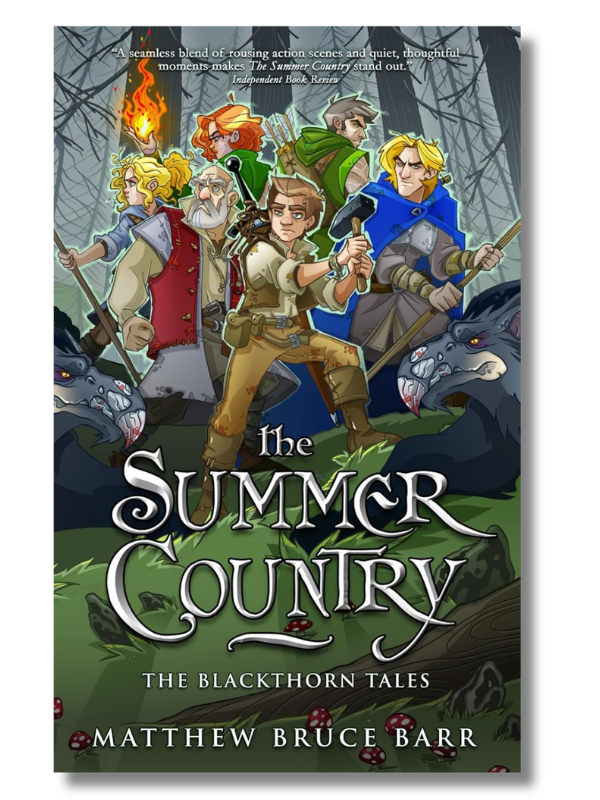
An epic quest about the clash of good and evil, the forces of friendship, our responsibility to others, and coming of age in a violent world
The second installment in The Blackthorn Tales series, The Summer Country, returns to the world of Duncartha. Brannoch, a boy believed to be the secret to stopping a malevolent, undying sorcerer, is coming to terms with the battles and deaths of the previous book.
Despite his victory over Lord Bedlam and having wrested the mythic sword, Blackthorn, from him, Brannoch is plagued with guilt and nightmares. He still can’t come to terms with the people he’s lost and the fact of having killed another human being, even in self defense.
Yet, there’s little time to dwell on this suffering. Though Bedlam was killed, his forces continue to gain strength and mount attacks. The possibility of Bedlam himself returning to life is ever present.
With a small group of friends and mentors, Brannoch sets off for The Summer Country, a wasteland that was once the verdant home of the elves, in order to uncover answers about the Blackthorn’s powers and the secrets that allowed a long-ago hero, Tal Rij, to kill Bedlam and imprison his soul for generations.
“A sword is rarely ever just a sword. Think of all that a sword can mean. Defense. A rallying point. A deterrent. A symbol.”
A glorious medley of characters fill these pages. There’s Brannoch, the sensitive, precocious young leader at the book’s heart, but also Ein, Calion, Galadric, and Leli, the brave friends who accompany him, each possessing unique powers and skills of their own. There’s Mister Gern, a talented magician and mentor to Brannoch. There’s also Tinelanin, the faithful, dangerous daughter of Bedlam, whose kinetic escape from prison begins the novel.
As chapters dance between these various perspectives, different plot lines take shape and spill outwards, broadening the novel’s world and leading to a rich collage of relationships, identities, and landscapes. Even the commanders of Bedlam’s remaining fighting force are given space and allowed to become driving characters in the story. This ability to imagine diverse voices, to plunge into wildly differing perspectives, and explore the vast world of human motivations—both cynical and sincere—gives the book its lively, three-dimensional quality.
“‘The Summer Country,’ she said, pointing ahead of her. There was nothing to indicate that they had reached the border between two nations. The land ahead looked much like the land behind. There was something, though. Something in the air. Like it had been drained of much of its color… and the sky rolled ever onward.”
A seamless blend of rousing action scenes and quiet, thoughtful moments makes The Summer Country stand out. So much of the story hinges on history, on what has been lost, and on salvaging the remembrances that are left. For an adventure novel, there’s a refreshing amount of attention given to the way the past informs the future and the need to return to the deeds of old. Efforts to learn about what happened to different species of the land, the elves, the Deredani, and so forth, are imbued with a vital necessity and sense of drama.
Knowledge has real power in this story. When transitions occur, shifting from introspective reflections to moments of battle, they come hard and fast with bursts of raw adrenaline. There’s a deft control of pace, an ability to show time expanding and contracting depending on the moment, that makes for an engrossing read.
“‘Do you know what magic is?’ he inquired. Leli was surprised for a second. It seemed like an obvious question, but there wasn’t any obvious answer.”
Drawing as it does on epic literary fantasies like The Lord of the Rings and the Game of Thrones series, The Summer Country is an adept installment in a grander series worthy of its references. The book stands alone by reintroducing old characters and creating its singular universe of swords and sorcerers, trolls and dragons anew, yet it also contains a sense of something larger. There’s a deeper story behind every action that gestures toward the book that came before, and a longer quest that extends beyond the closing page. The love, loss, and loyalty that bond Brannoch and his friends will push readers forward through this book and leave them longing for the next one.



What did you think?