


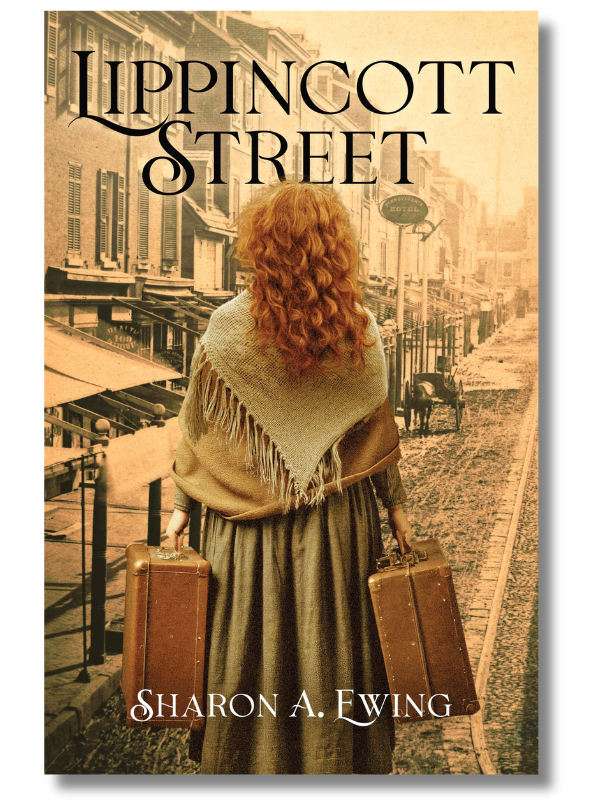
Lippincott Street
by Sharon A. Ewing
Genre: Historical Fiction / Literary
ISBN: 9798891328068
Print Length: 324 pages
Publisher: Atmosphere Press
Reviewed by Addison Ciuchta
A touching historical novel about the hardship and hope of Irish immigrants in the 1860s
Lippincott Street by Sharon A. Ewing opens with Cate Leary and her sister, Mary Alice, on board a ship sailing for America. After some hardship and illness on board separates the sisters, Cate is left on her own when she disembarks the ship in Philadelphia, seeking out her brother who was supposed to meet them at the dock.
But her brother is nowhere to be found and Cate must deal with the large, foreign city on her own, running into thieves, dangerous streets, and desperate for employment so she can afford to board somewhere safe. Eventually, the siblings reunite, each of them struggling under the pressure of making a life for themselves in a city that isn’t so accepting to Irish immigrants. Along the way, the siblings experience many tragedies, both great and small, navigate the looming Civil War, and try to forge a happy future in their new home.
Lippincott Street is chock-full of emotion, the reader thrust into the points of view of Cate, Mary Alice, and Johnny Leary as they deal with personal and societal pressures from their lot in life. The writing style is descriptive and beautiful at times, ringing with a particularly strong sense of subtle beauty and hope even as the trio experience hardship after hardship. It’s by no means a cheerful novel, fitting the tone to the historical setting and the main characters’ situations, shedding light on the prejudice they experience from Americans, the in-fighting between some of Irish immigrants, the difficult and often dangerous work offered to them, and the rising tension of the upcoming Civil War.
“The sailors worked together like a well-oiled machine until under a stiff breeze the vessel caught the river’s current.”
Cate, whom readers get the most perspective from, is a strong main character with a steely determination and self-sacrificial attitude that will win anyone over. It’s to a fault, almost, the lengths she will go for her siblings, pushing away nicer living conditions, new outfits, and even a blooming and very sweet romantic relationship in order to support her siblings.
Mary Alice and Johnny are just as well-rounded, though they go about their hardship in different ways. Where Cate suffers in silence, Johnny’s attempts to get out of trouble only seem to double it in bloody and violent ways, while Mary Alice ogles shop windows and cute boys and complains about her employment as the companion to an elderly woman, showing her youth and naiveté. They all pose different perspectives on the time period, society, and the treatment of Irish immigrants in the 1860s in engaging and sympathetic ways.
“One bag lighter, Cate gathered her courage, her faith and stepped into the turbulence of urban America.”
The dialogue may take some getting used to, as it’s written to reflect the characters’ speaking with an Irish accent. At first, this is jarring as “your” becomes “yer” and “it is” becomes “’tis,” for example, but it becomes easier to follow further into the novel.
It is a rather somber book with tragedies that seem to pile on top of each other, weighing Cate and her siblings down. Without getting into spoilers, death, prejudice, sexual harassment, and war are just a few themes that are explored throughout the story. There are also some minor scenes involving dog fighting which may turn off some readers. Don’t go into this thinking it’ll be a happy story from start to finish. The characters go through the worst of the worst at times. However, this makes Cate’s determination and undercurrent of hope all the more impactful as she works through anything the world throws at her. It’s not that she doesn’t waver or get angry or break down, it’s that she keeps getting back up again when she does.
“With the drapes drawn against the sun, Mary Alice settled in a chair positioned in a corner of the dark room, left to ponder a future that already held more than its share of disappointments.”
Lippincott Street is an emotionally resonant snapshot of the life of Irish immigrants in the 1860s, hardship and all. It’s sad, yes, but also stunning with quietly beautiful prose and characters who inspire hope even in the face of the truly terrible.
Thank you for reading Addison Ciuchta’s book review of Lippincott Street by Sharon A. Ewing! If you liked what you read, please spend some more time with us at the links below.



What did you think?