


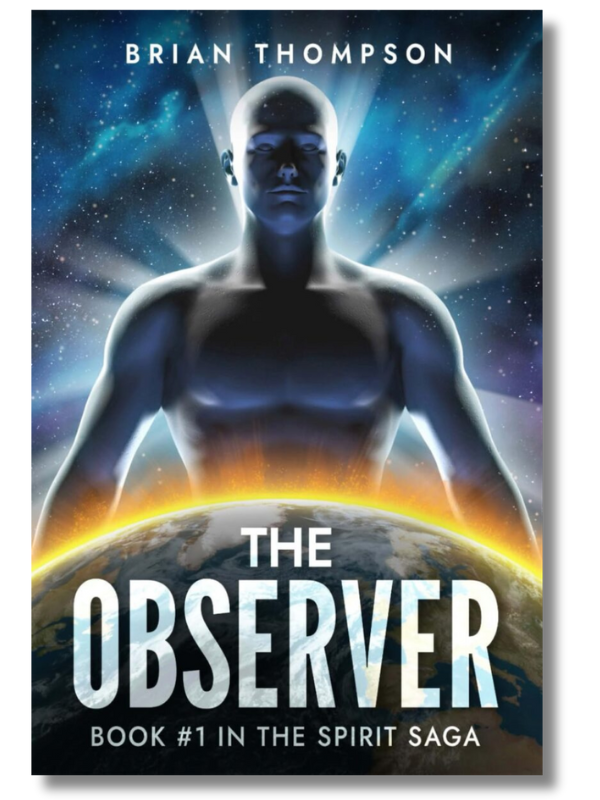
The Observer
by Brian Thompson
Genre: Fantasy / Supernatural
ISBN: 9798218727444
Print Length: 454 pages
Reviewed by Warren Maxwell
An action-packed journey into a spiritual realm parallel to our world
“I say history of the universe and you think it’s a ‘little story’ I’d hate to see what you’d consider a big story.”
Religions incarnate, fate-defining battles, a man uncovering who he is—setting an epic saga in motion, The Observer by Brian Thompson introduces Frank, a man who, having died, finds himself in a spiritual realm with no memory of who he was in his life or how he died.
Michael, a 4000-year-old spirit in a teenager’s body, greets Frank and begins the long process of introducing him to a world that exists and impacts our own. Leading Frank through the origin stories behind modern history and religion, introducing him to incarnate spirits from the Judeo-Christian tradition—including Adam, Eve, and Jesus—and teaching him his powers as an “Observer” spirit, one who is constitutionally bent on helping humans and feeling their guilt and pain in response to their suffering, Michael guides Frank into his new role and life while uncovering the secrets of his past identity.
Yet it soon becomes clear that not all is as it seems. Millenia-old tensions come to the surface between old gods, vengeful, dark gods, and the Elders, the oldest surviving human spirits. Frank finds himself caught in the midst of this simmering conflict not least because his preternatural ability to harness power as a spirit has led some to believe that he may be the long-awaited Chosen One, a human spirit powerful enough to confront the gods.
“What an absurd thought. I can’t be dead. If I were dead, well… I wouldn’t be having this conversation with myself. I’d be… dead. I look at the man in the bed. That is definitely me.”
The Observer is many things. It’s a story of finding one’s place in the world—even if that world is an afterlife. It’s a tale of good, evil, and the fine line between them. It’s also a book about the dangers of lying, the suffering of living, and the capacity for humans to join together with compassion and support one another, even after death.
Incisive scenes show the pain of loss driving people into addiction and alcoholism, the rage that boils over when we are hurt, and the chain reaction it causes. In imagining a realm of different kinds of spirits—beyond the benevolent Observers, there are Tricksters, who live up to their name without definitely erring on the side of good or evil, Guides like Michael, and then Demons, the malevolent forces behind so much pain and anxiety in the human world.
Among the book’s many fascinating innovations is the way it shows Demons and Observers directly battling each other through human surrogates by influencing those people for the good or the bad. Particularly in descriptions of tragedy, addiction, and intrusive thinking, the manifestation of a Demon whispering in the human’s ear offers a striking, visual way of understanding how bad events unfold.
“‘That is the Jesus? But he looks nothing like Jesus.’ ‘He looks exactly like Jesus. Surely you didn’t think Jesus, a man born in the middle-east to a poor carpenter, would look like he does in the paintings. When was the last time you saw a white Hebrew with long flowing, shiny brown hair? While Jesus was human, he was a poor, homeless wanderer.’”
The worldbuilding and depth of imagination that goes into this book are simply marvelous. It single-handedly creates a new human origin story—braiding many myths and religions into a compelling understanding of both human history and the human soul.
Often, the book’s shortcoming is that it gives too much time and attention to these expansive sections of universe and history building. There is a density and preponderance of detail that is not always necessary—some origin myths spill out across multiple consecutive chapters and slow the plot’s movement. While there is intrigue and a deep level of thought throughout, these digressions weigh on the pacing and force the book to take too much time to establish its central narrative and conflict.
“I am pain. Franklin Joseph Hess no longer exists. Pain has manifested itself in my place.”
Beyond questions of narrative development, the prose is lucid and captivating. While occasion lines of dialogue feel stilted, The Observer is excellent at establishing large stakes and then allowing action and narration to carry the momentum forward. Scenes of extreme violence, though sparse, have an almost palpable, stomach-churning effect that mirrors Frank’s own response to human suffering as an Observer. Simply witnessing injury or death causes blinding pain to shoot through him and renews his urgency to help people. This ability to draw us into the world, both through Frank’s perspective and the literal composition of detail on the page makes for a gripping read.
An epic adventure about spirit realms, hidden truths, world religions, and the basic realities of being human in a hostile world, The Observer is the strong first installment of what appears to be a fascinating new series.
Thank you for reading Warren Maxwell’s book review of The Observer by Brian Thompson! If you liked what you read, please spend some more time with us at the links below.




What did you think?