


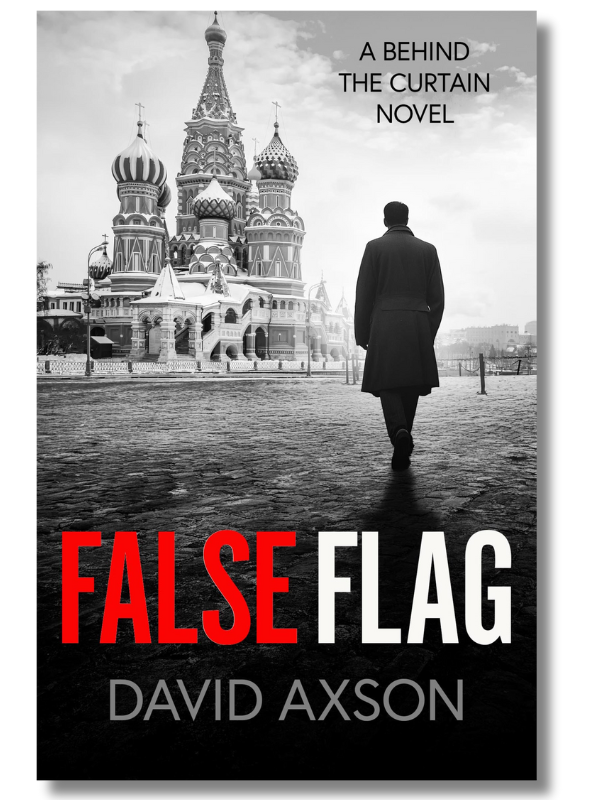
False Flag
by David Axson
Genre: Mystery, Thriller & Suspense / Spy
ISBN: 9798992814002
Print Length: 408 pages
Reviewed by Erin Britton
A tense and atmospheric Cold War thriller with an atypical spy
False Flag, the first book in David Axson’s Behind the Curtain series, is a Cold War thriller that mixes documented historical reality with rip-roaring action and intense political intrigue. It explores the covert exploits of an atypical spy as he navigates the treacherous world hidden behind the Iron Curtain.
Nic Slater follows an unusual path to international espionage. Born in a mining village outside of Sheffield, his parents hope he can escape working class drudgery (“Food rationing was pervasive, local industry in decline, and the promised postwar economic boom had taken its time in materialising.”) by going to university; however, it is his fluency in Russian and a seemingly chance encounter in a pub that secure him a role with the Foreign Office.
Of course, it’s a classic cover for recruitment to the Secret Intelligence Service (SIS), provided he can pass the grueling six-month training program. “Those that did would be assigned to either MI5, domestic intelligence, or MI6, overseas intelligence.” Alongside the brutal physical fitness regimen, smoking and seduction lessons, and le Carré-style tradecraft practice, Slater learns to move in London’s high society, hobnobbing with the great and the good.
Espionage isn’t all champagne and caviar though, and Nic’s first posting entails being sent to Moscow to “serve as an economic affairs attaché focused on Anglo-Soviet trade.” With the SIS’s ranks having been depleted by high-profile defections, Nic is there to help rebuild Britain’s “intelligence network behind the Iron Curtain as the Cold War heats up.” He expects it to be mainly administrative work, although he soon becomes embroiled in far more action and intrigue than he ever imaged.
Meanwhile, also in Moscow, three-year KGB veteran Irina Sashkaya is called into a meeting with the Foreign Minister, Andrei Gromyko, and the KGB Chief, Vladimir Semichastny. “Politburo members rarely engaged with such junior staff.” Irina learns that the Soviet policy of peaceful co-existence since 1956 has actually been a cover for Operation Vanquish—“All these events were orchestrated directly by the Soviet Union as part of a long-term strategy to destabilize the West.”
Irina and fellow KGB officer Yuri Kovlev are to play a key role in the ongoing deception. “You will infiltrate these new networks, posing as recruitable double agents and serve as conduits for a flow of disinformation that will mask the truth about Vanquish.” When Nic is identified as a good target by the KGB, it is Irina who is tasked with getting closer to him, with appealing “to his proletarian roots, emphasising the damage the British ruling elites have inflicted on the working class.”
False Flag is something of an epic at over 400 pages in length, which gives David Axson plenty of scope to establish the backgrounds of both his characters and the Cold War more generally. As such, the story is richly detailed and packed with historical factoids and insights, enhancing the environment and atmosphere of the narrative and making for an immersive read.
As Axson makes clear from the outset, Nic Slater is not the kind of spy that the Soviets would have expected to be sent to Moscow in 1964. A working-class northerner with a degree from a bog-standard university, he stands out like a sore thumb among the upper-class Oxbridge graduates that dominate MI5 and MI6. “Nic felt like a museum exhibit as each one cast an appraising eye over the strange working-class specimen who had clearly escaped from the servants’ quarters.” He might have a bit of a chip on his shoulder, but he’s not wrong about things.
This class contrast represents a significant point of difference from the majority of characters in the spy genre, with Nic even standing out compared to the Slow Horses and the George Smileys. His fish-out-of-water experiences in both Britain and Russia render him a particularly relatable character, and he never comes across as the kind of superspy who is bound to topple the forces of Communism Bond-style. This makes the situations Nic finds himself in particularly tense due to the real possibility of him facing serious harm.
Axson makes it clear that the shift in perspective at the SIS is not down to any egalitarian principle inspired by the changing world of the 1960s. Instead, it’s due to a need to avoid further embarrassment after the scandals of the Cambridge spies and the Profumo affair. Reflecting on how “English intellectuals were seduced by the idealism of Marxism and believed the Soviet Union offered the best hope for a new, more egalitarian society,” Axson incorporates numerous historical details and asides that really enhance the story, expertly delivering fact and fiction.
For her part, at first glance at least, Irina Sashkaya fits the mold of a KGB agent much neater. She is bold and dedicated to the cause of furthering Soviet interests at home and abroad, but she is “aware of the vast gulf between the theory of Marxism-Leninism and its practical manifestation in the Soviet Union.” While far from an ideologue, she has just the kind of cynical and ruthless streak necessary to succeed as a spy, and Axson keeps it opaque whether she should be viewed as a hero or antihero as matters progress.
Irina’s role also highlights the sexism inherent in society in general and the espionage community in particular, as well as the pivotal role that sex often ends up playing in international intrigue. While she is acknowledged as a valuable KGB asset and given the important role of recruiting Nic, she still faces casual sexism ad microaggressions. “It was one of the many cracks in the façade of the perfect socialist state offering equality to all. Women were not equal; they were merely there to serve men.”
Axson’s worldbuilding is just as good as his characterization. Nic, Irina, and those they encounter face realistic situations in believable locations. The contrast drawn between the glitz and glamour of London high society and the conditions of the working class is strong and emotive, painting a grim picture of life in much of Britain. “It was a desolate landscape. Undeveloped bomb sites, decaying housing, putrid smells, and thick early morning smog created an oppressive environment. All this in a country that had supposedly won the war.”
Life in Moscow is equally well evoked, with Axson describing the stark contrasts between Tsarist architecture and Soviet brutalism well. The contradictions and uncertainties of life behind the Iron Curtain are clearly brought out, but so are the odd plus points. Irina loves her country and Nic revels in his time in Moscow, despite knowing that his is “a job where the price of failure was most likely death.” The mental gymnastics they both have to go through to do their jobs help make them and their situations all the more real.
In addition to the historical accuracy and social commentary, False Flag also features the action, intrigue, and deadly danger to be expected from a spy story. It’s clear from the prologue that rather than being confined to desk duties, Nic is going to end up in the thick of things, even if he feels unprepared for it.
Offering a fascinating tour of the places, people, and situations that shaped the hostilities between East and West following the end of World War Two and the construction of the Berlin Wall, False Flag is an immersive thriller packed with rip-roaring twists and turns. Given that it is the first book in a planned series, it’ll be interesting to learn what else the Cold War has in store for Nic Slater.
Thank you for reading Erin Britton’s book review of False Flag by David Axson! If you liked what you read, please spend some more time with us at the links below.



What did you think?