


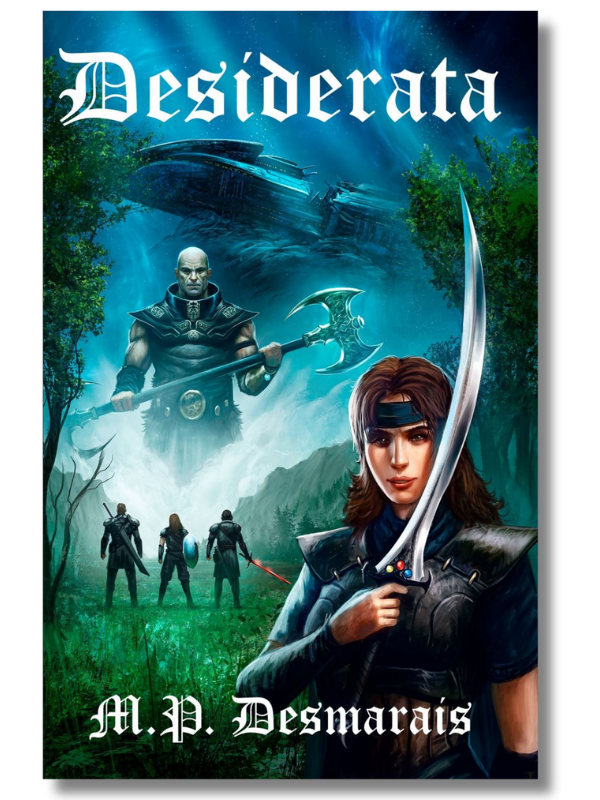
Desíderata
by M.P. Desmaraís
Genre: Sci-Fi & Fantasy
ISBN: 9798992323528
Print Length: 372 pages
Reviewed by Erin Britton
A high fantasy and science fiction mashup with serious eco credentials
Set in a world on the brink of disaster, Desiderata by M.P. Desmarais offers an unusual and exciting blend of high fantasy, science fiction, and action-packed adventure.
The empire of Ezmondia, ruled over by the bloodthirsty tyrant Armando, dominates the continent of Gracyr and stands in constant opposition to its neighboring country, Makeva. However, for all the empire’s wealth and power, it still faces peril: the hydropower systems are failing across Ezmondia and wider Gracyr.
These power failures are “a consequence of relying on power plants that were dependent on water for generating electricity, in what was an increasingly dry environment across the continent.” As a total loss of power would be a disaster for everyone, it is fortunate that a solution might be available in the form of a strange material dubbed promethium, which was bought to Gracyr in an alien spacecraft generations ago. Things are never that simple, though, and it will take a strong band of formidable adventurers to secure the power source before Armando manages to exploit it.
Gerrard is a legend across Makeva, a famous swordsman who has been winning the city of Nethereel’s annual tournament for years. Still, while he continues to have unmatched fighting spirit, Gerrard has begun to realize that his skill and strength might be starting to betray him. It’s lucky then that, despite all his success, Gerrard has always hoped to do something more meaningful with his life than fight for sport.
Andromeda, “a somewhat ragged-looking female fighter, rough-edged and likely not coming at him from a place of wealth and success,” is the one who comes closest to preventing Gerrard from enjoying another tournament victory. As she admits defeat in the final round, Andromeda reflects on how the experience might prove useful. “She often strived to mentally uncover and dissect the talents and skills of others, and to consider what they could accomplish with her help—or what she could accomplish with theirs.” This soon proves to be remarkable foresight.
Whereas Gerrard and Andromeda fit into life in Makeva perfectly, Regina is “pondering her own inability to fit society’s various cookie-cutter molds.” She had pursued an ill-thought-out dream of winning the tournament, but her real talent lies in strategy rather than combat. “She was constantly challenging herself, making herself question what she believed, and was always striving to improve herself.” It is her introspective and curious nature that causes her to spot agents of the Order of Oranlak at work in the city, chasing a young man through the crowds.
That young man is Hector, and he clearly has some sort of trouble in mind. After using impressive shadow magic to conjure a spectral scorpion and dispatch the agents who were chasing him, Hector explains his motivation to Regina: “I suppose I was thinking my life needed to be made a little more interesting, and felt this whole thing seemed a grand opportunity.”
When these four seemingly disparate individuals are brought together at a waterfall outside of Nethereel that happens to be the staging point for various nefarious activities on the part of the Order of Oranlak, it appears that fate has sought to turn them into a team to combat everyday villainy in Makeva. However, over the course of the truly epic quest they find themselves launched into, the team of four end up pursing the elusive new power source, which places them on a deadly collision course with Armando.
With its focus on the four bold heroes—Gerrard, Andromeda, Regina, and Hector—Desiderata is a true ensemble piece. M.P. Desmarais introduces each of them separately, allowing them all a moment to shine as individuals and indicating the unique talents they will each bring to the team, before having them meet together at the waterfall and join forces in a plausible, organic way. And as their subsequent journey progresses, they all manage to grow and learn over the course of their quest, which is a true hallmark of the fantasy genre.
This strong characterization adds considerable depth to the story, with the foibles of the central four bringing most humor and pathos to proceedings. In particular, the sniping and wry observations among them are often very funny, and this touch of humanity ensures that the four remain relatable despite their fighting prowess and magical capabilities. The fact that they seem very “real” also makes the various moments of peril and danger feel especially real, such as Gerrard dragging himself after the others despite having been poisoned and tortured.
Equally compelling are the story’s villains. Armando is, of course, the main antagonist, and he’s an intriguing mix of seemingly invincible warrior, megalomaniacal politician, and petulant adult baby. “That was the way with Armando: he wanted quick and easy answers to vastly complicated problems. And he wanted a solution in line with how he viewed the world—an effortlessly digestible solution, and preferably one that wasn’t going to take long to materialize, either.” He’s certainly evil and deeply dangerous, but he’s also secretly a bit pathetic, which is probably why he needs the likes of Mercedes and Ursula.
Compared to this excellent characterization, the worldbuilding gets a little less attention, which is a shame given the fascinating and unique qualities that Desmarais has envisioned for Gracyr.This integration of both modern and as yet unrealized technology with the tropes of the fantasy environment is an excellent idea, and it would have been great to read more detailed descriptions of what the various places look like and how they function on a practical basis. Even the fight scenes involve a mashup of space-age technology and archaic weaponry: “Pick up your sword, your blaster. Come at me with something, with everything!” Relatedly, the idea that magic is disappearing from the world, and that technology will presumably be taking over its many roles, is an intriguing one.
Magic seems to be disappearing from their world, but this isn’t the only peril facing the citizens of Gracyr. The failure of the hydropower systems due to the drying world neatly reflects the contemporary problems of climate change, which renders the danger and sense of impending doom faced by the characters even more relatable.
Among the other modern issues that Desmarais weaves into the story are a declining birth rate. While Armando worries about such reproductive issues because they result in less young soldiers available to serve in his army, more altruistic characters such as Gerrard are more worried about the pervasive influence of the media. “Massive media campaigns were spread out over the ubiquitous vidscreens and other media throughout nearly all residences of Ezmondia. They conditioned the people.” These contemporary concerns work surprisingly well as issues in the fantasy world of Gracyr, providing extra motivations for both Armando’s evil machinations and other characters’ commitment to standing against him.
All these touches combine to make Desiderata a surprising and exciting story. With the mix of fantasy and science fiction being coupled with deadly danger, battles, and spellcasting, there is never a dull moment in this novel. Indeed, despite it being an epic, the plot positively whizzes along as Gerrard, Andromeda, Regina, and Hector search for the elusive promethium and a way to overthrow Armando. The fate of Gracyr depends on them, and this makes for a deeply compelling quest in the end.
Thank you for reading Erin Britton’s book review of Desiderata by M.P. Desmarais! If you liked what you read, please spend some more time with us at the links below.



What did you think?