

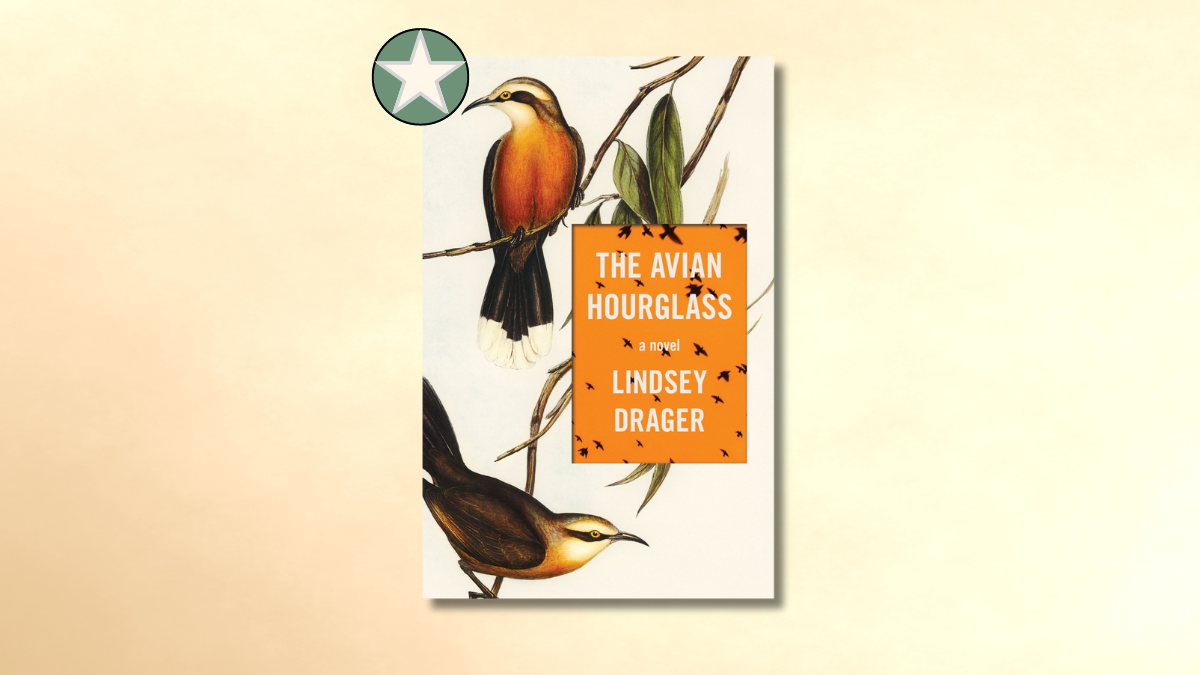
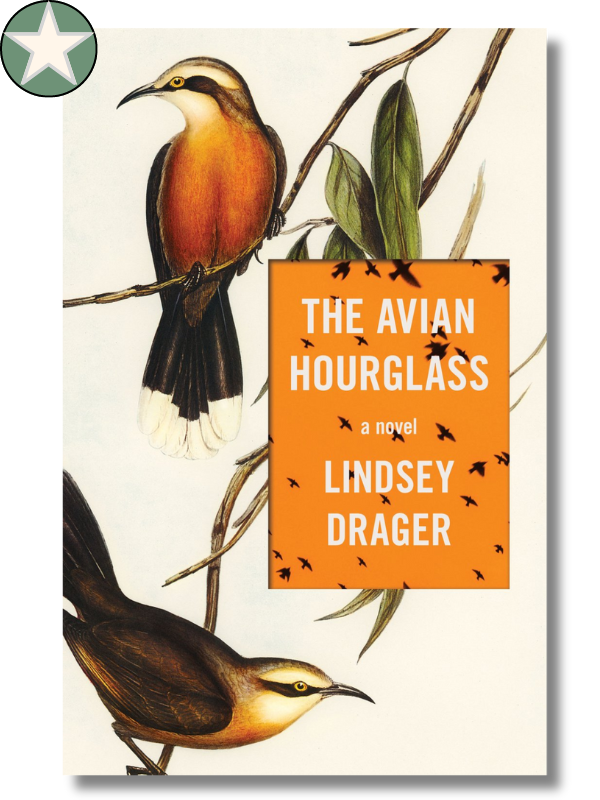
The Avian Hourglass
by Lindsey Drager
Genre: Literary Fiction / Surreal / Climate
ISBN: 9781950539970
Print Length: 212 pages
Publisher: Dzanc Books
Reviewed by Nick Rees Gardner
questions of technology, found family, the universe, the body—explored in a way that is as uniquely Drafer as it is ubiquitous
In a small no-name town that feels like it’s enclosed in a snowglobe, our narrator’s future is uncertain. She drives a bus that’s slated to be replaced by a self-driving one. The “Crisis” is growing worse. And the birds and stars are gone.
The woman struggles to raise her triplets, which she carried as a gestational surrogate until their “intended parents” died in a car accident, and now she lives in one half of a duplex, the other half occupied by Uri, the triplets’ uncle.
Human-sized bird’s nests pop up throughout the town and the divisions between the “YES” people and the “NO” people become muddied as the Crisis peaks. While the narrator discusses these changes with her friends she begins to wonder if this is just a town she lives in or if it is the entire world.
All of Drager’s characters stand out in unique ways, each serving a different purpose for the narrator. Uri, the triplets’ uncle, is writing a play about Icarus and dons false wings, shares beers with the narrator to rehash their troubles. And Sulien, a stable friend, feeds the narrator facts about birds while the narrator’s Aunt Luce pitches etymologies of words, lending the depth of origins to the names of planets or words like “crisis,” “theory,” and “theater.”
Luce explains about words, that “with their meaning always changing–sometimes it’s useful to remember their roots.” This is a beseeching of the reader to dive deeper into the themes, metaphors, and references. As Uri’s unfinished play questions where Icarus’s story really ends (at the fall or while still in flight) the unnamed triplets mimic a Greek chorus with their wise or ambiguous questions.
While Lindsey Drager’s novel can be read at a surface level as an accounting of the town’s downward spiral, or as a work of climate fiction preaching resilience and hope through human connection in a waning world, it offers many deeper questions.
The woman discusses her fathers’ globe making practice, the way that they constantly altered their globes as names changed and borders shifted due to wars or political unrest. She goes on to explain “the invisible strife that came with those changes, the wars and loss and horror and struggle, but also the liberation and joy.” All of this contained in and radiating out of a stationary orb. The narrator seems to be talking about more than just the globes in this statement, referring to her encapsulated town, but also to her own “invisible strife” as she persists through her world’s own changes.
Drager accomplishes all of this in just over two hundred pages, a countdown of numbered sections beginning and ending at 180 which is “half a circle, but also a line.”
At a sentence-level, Drager’s prose will hook any reader, sonorous and rhythmic enough to dwell on the poetics alone. Similarly, the ideas proposed, delving into each and every image, analogy, or reference, can last long periods of time lingering on each page.
Depending on the reader, The Avian Hourglass is a book that one could spend a couple days with or a couple years and still be satisfied or unsatisfied depending on their wont. However far down the rabbit hole the reader wants to go, Drager’s is a novel of surreal literary fiction that opens gateways to a world in which the reader can reflect, indefinitely, on many aspects of their own life.
Thank you for reading Nick Rees Gardner’s book review of The Avian Hourglass by Lindsey Drager! If you liked what you read, please spend some more time with us at the links below.



What did you think?