


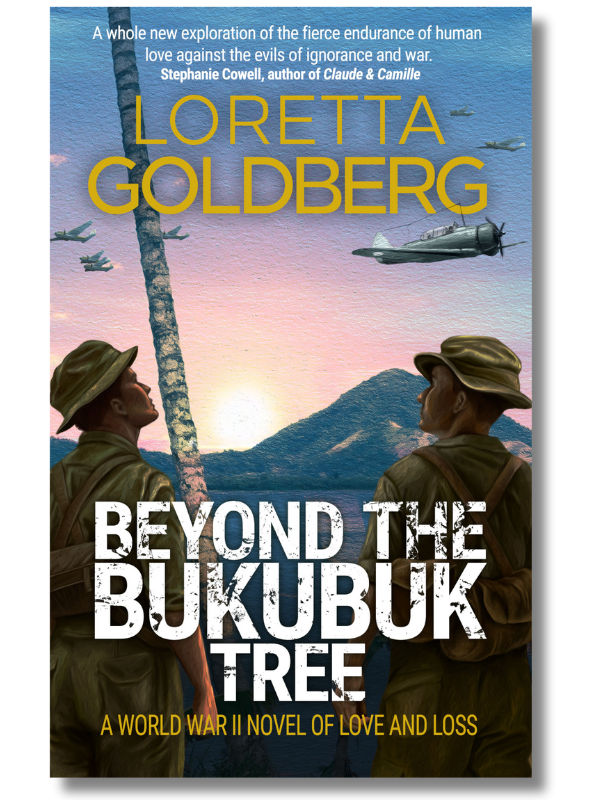
Beyond the Bukubuk Tree
by Loretta Goldberg
Genre: Historical Fiction / WWII / LGBTQ
ISBN: 9788412232585
Print Length: 375 pages
Reviewed by Erin Britton
A tumultuous love affair between two Australian soldiers stationed in New Guinea unfolds in the midst of World War Two.
An epic and tumultuous love story set in an exotic location marred by war and the devastating consequences of colonial occupation, Loretta Goldberg’s Beyond the Bukubuk Tree vividly captures New Guinea during World War Two. For two Australian soldiers stationed in Rabaul, the capital of New Guinea, surviving the conflict will also entail confronting traumas from the past and the possibility of happiness in the future.
It’s 1941 and Valentine’s Day is proving to be far from romantic or celebratory for Doctor Jake Friedman. Jolted awake by the sound of his alarm clock, he’s saved from having to continue to the end his regular nightmare: He and three nurses are driving through dangerous conditions to attend a possible polio outbreak among some children. “He hadn’t seen around the curve in the road. He hadn’t seen the spilt gravel or broken beer bottles, nor had he felt the tyre flattening. The car had skidded and overturned.” While Jake and two of the nurses emerge from the accident relatively unscathed, the third, Grace, is crushed to death in the wreck.
The actual accident took place three months previously and the police have cleared Jake of all responsibility, blaming the road conditions that night. “Still, he couldn’t clear himself. He’d learnt that the children he was rushing to treat did have paralysis polio and were immobilised long-term in the standard protocol.” The guilt of lives lost and lives ruined weighs heavily on him. So much so, in fact, that it spurs him on to enlist in the Australian military despite being exempt from service in World War Two due to his profession and the concussion that the accident left him with.
“In wartime, casualties should be like ration coupons, redeemable for worthy items in war service. He loathed fascism and loved the British democratic system that provided dignity and safety to Jews. Any future accidents involving him must happen in uniform.”
Contrary to expectations, rather than being posted thousands of miles away to the battlefields of Europe or North Africa, Jake is sent to Rabaul, “the capital of New Britain island, the northern tip of Australia’s mandated territory of New Guinea. Its sleepy heat was legendary.” This involves a nine-day trip on a troop transporter, the SS Zealandia, where Jake becomes acquainted with his fellow soldiers and their medical complaints, mainly seasickness and STDs.
During the voyage to Rabaul, Jake also becomes acquainted with Captain John Alexander Whipple, whom he first meets in the medical bay after Alex has been seriously injured while standing up for another sailor. There’s an instant attraction between the two men.
As Jake settles into life as a member of Lark Force, where the exotic flora and fauna, the looming threat of the belching volcano, and the traditions of the indigenous islanders only partially distract him from the numerous culture shocks associated with life in the army in a particularly under-resourced and disease-prone area during wartime, he finds himself drawing closer to Alex. It’s a complicated situation that becomes even more dangerous when Rabaul ceases to be a forgotten, out-of-the-way outpost. In fact, despite widespread belief in its unimportance, “Rabaul has the best harbour in the southern hemisphere, and Nazi policy is to retake it.”
When the Japanese invade and their battalion is abandoned by the Australian government, Jake and Alex must find ways to survive in an increasingly hostile environment, but will the new dangers and challenges bring them closer together or tear them apart?
Beyond the Bukubuk Tree is a richly detailed and highly immersive work of historical fiction. Loretta Goldberg has clearly conducted a great deal of research into the history and geography of New Guinea, and she obviously has a tremendous amount of respect and admiration for the country and its people, but the book wears her research lightly. The story always comes first—with all its action, danger, and romance—and the provision of information is a secondary matter that serves to enhance the plot and add depth to both characters and events.
Goldberg also exhibits in-depth knowledge of a lesser known conflict fought in the Pacific Theater during World War Two in choosing to set the story during the Japanese invasion and occupation of Rabaul. The military aspects of the story seem spot on, from the banter between soldiers, to the conflicts between ranks, to the ego trips that plunge innocent parties into grave danger. She also doesn’t shy away from the complex, sometimes peculiar, and often gruesome medical matters that army surgeons such as Jake encounter, whether “a marvellous fungus,” “a tropical ulcer,” or something far more gory. Such matters really drive the realism of the story.
Of the two main characters, Jake is probably the most knowable, while Alex is arguably the most comprehensible. Despite being a not particularly observant Jew, Jake understands his family’s desire for a Jewish homeland and he joins the military in the knowledge of what Jews in Europe are suffering and with the desire to help stop the scourge of Nazism. He also knows that his religion means “making a Jewish family was the ultimate virtue,” which is why he has agreed to marry a nurse named Esther—who he maybe loves or maybe just feels grateful toward—after the war. In fact, there’s an awful lot that he expects will “be sorted after the war.”
Despite the uncertainly caused by being pulled in different directions by his religion, family, career, and patriotism, there is one thing that Jake is certain about: how he feels regarding Alex. Having been aware of the danger and difficulty associated with being homosexual since his teenage fumblings with a schoolfellow came to light, he has limited romantic experience—excluding that with Esther—but he’s determined to pursue intimacy with Alex.
Alex is somewhat older than Jake, which means that as a young man he saw a year of service in Europe toward the end of World War One. That experience, together with the relentless physical and mental bullying he was subjected to as a child due to his perceived femininity and his love for dance, has scarred him, although it has also left him quick to stand up for the underdog and the oppressed. He is also haunted by what he had to survive for a while in the post-World War One milieu, leaving him world-weary and resigned. While Alex is notionally the bravest of the pair, Jake also finds his courage during the conflict, and the two of them face great tribulations in their quest for survival.
Aside from Jake and Alex, there’s also another forbidden/clandestine romance in Beyond the Bukubuk Tree: that between Chinese-Australian deserter Henry Lee and betrothed Tolai teenager IaKumu. Through their relationship, Goldberg is able to explore the conflict between tradition and modernity, as well as to highlight issues of racism and sexism that were prevalent at the time. She also brings out the traditions and practices of the Tolai people, including their medicinal use of certain herbs and plants, which represents an almost unique and particularly enlightening aspect of the book.
Full of emotion, action, and a host of human frailty, Beyond the Bukubuk Tree is a thrilling and heart-rending story of love and survival set against the backdrop of one of the most bloody conflicts the world has ever seen. It is an epic, informative, and often surprising work of historical fiction that’ll move you.
Thank you for reading Erin Britton’s book review of Beyond the Bukubuk Tree by Loretta Goldberg! If you liked what you read, please spend some more time with us at the links below.





What did you think?