

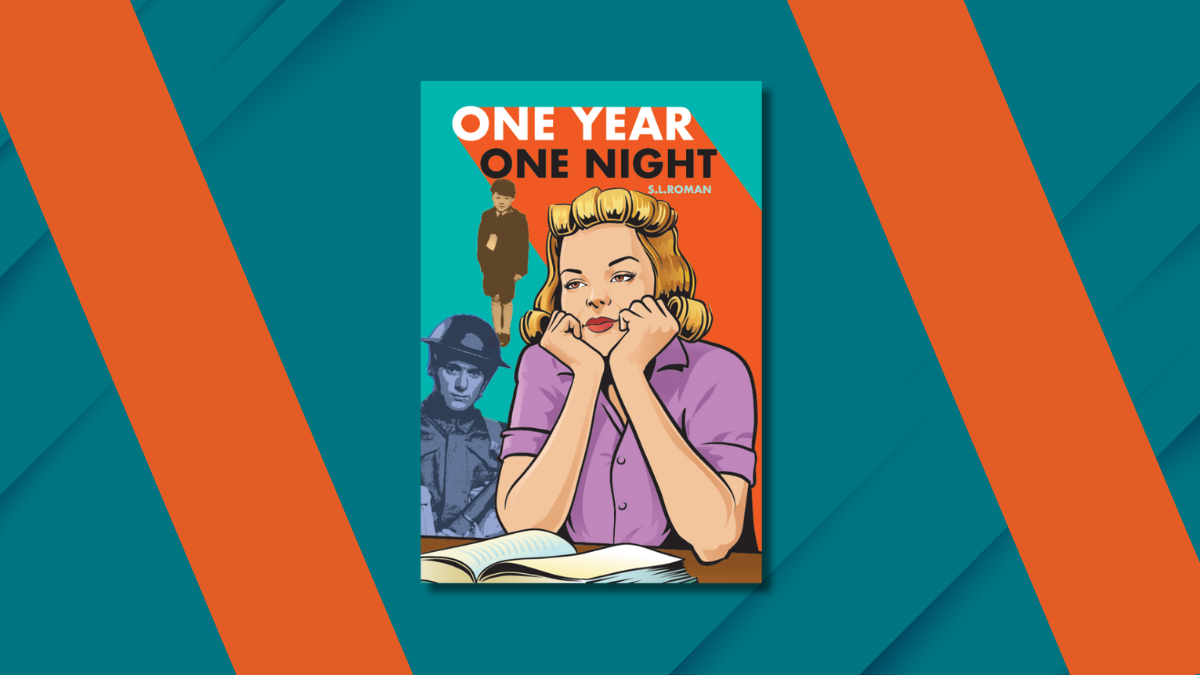

One Year, One Night
by S.L. Roman
Genre: Historical Fiction
ISBN: 9781947159815
Print Length: 152 pages
Publisher: One Elm Books
Reviewed by Erin Britton
Events from the past cast long shadows when a young woman remembers coming of age in the dark days of World War II.
Life on the home front proves to be nearly as precarious as life on the battlefield in One Year, One Night, S.L. Roman’s dual timeline historical novel for young adults.
Told from the perspective of a young woman who was a teenager at the outbreak of World War II and who found events from that time impossible to forget later in life, it explores how major happenings on the global level can have myriad consequences for average people on the local level, bringing both danger and opportunity and changing the courses of lives forever.
In 1960, 36-year-old Annie Corbett has rather reluctantly returned to Millside, the rural backwater where she grew up, to participate in a ceremony to mark the twentieth anniversary of the village being bombed in the run up to the Blitz. She has complex feelings about the occasion, particularly the participation of fading movie star Suzie Bell, although there might be some element of resentment or envy involved: “… nobody had a thought to spare for me even if I had been a key figure in the whole story, besides having been away from the village for many years.”
Still, she treats her return as something of a pilgrimage, revisiting old haunts, stopping off at the former site of her family’s hardware shop, and visiting the home of a fondly remembered neighbor, Mrs. Bassett. Annie actually has an ulterior motive in doing the latter, as the destruction caused by the bombing had necessitated her family moving into Mrs. Bassett’s house for several weeks, and when they had moved out, Annie had left her diary hidden in a wardrobe there.
She had begun writing in the diary on December 18, 1939, her sixteenth birthday, and having retrieved it some two decades after she had sought to metaphorically close the book on events described within its pages, Annie finds herself unable to resist reading her way back into the past. Of course, while her teenage musings start off mundanely enough, it doesn’t take long for the realities of living in a country at war to impinge on day-to-day crushes, friendship dramas, and complaints about family.
The first major change was the arrival of the diabolical Auntie Betty, who had decided to evacuate herself to Annie’s home in the country in anticipation of upcoming bombing raids on British cities. “The problem with her was that she disapproved of nearly everything and everybody, a sour-looking spinster with an even worse temper.” This upheaval was closely followed by Annie’s father deciding to volunteer for active service, meaning that she was left in charge of running the shop with only scant help from her mother and brother.
As local men began to be called up and so to leave the village, a regiment of professional soldiers was stationed in the area, much to the consternation of older villagers and joy of younger female ones. Although 16-year-old Annie was not immune to the excitement surrounding the soldiers’ arrival and the widening of the pool of potential husbands available in the village, 36-year-old Annie looks back on events more wryly: “I think the soldiers brought more life to our village, in more than one sense, as we had our own little baby boom the following year. Of course, it was in part attributed to the passionate embraces of the soon-departing-for-war husbands, but I still have my doubts.”
As the diary entries explain how life in Millside both changed and stayed the same in the early months of the war, and as Annie fills in the gaps that her younger self left when initially describing her thoughts and experiences, a picture emerges of a community on the brink of significant change, of individuals facing upheaval like never before, and of a young girl finding herself and coming of age in truly momentous times.
Seeing events unfold through the eyes of 16-year-old Annie provides a fresh but sometimes myopic or naïve picture of life in Millside, both her own and the lives of those she professes to know well. Due to her teenage preoccupation with her own thoughts and emotions, Annie can be startlingly insightful in her observations at one moment and then shockingly ignorant of the realities of life at another. She’s certainly not a deliberately unreliable narrator, but her limited worldview and occasional self-absorption mean that her diary entries sometimes include tantalizing hints at events occurring just outside of her line of sight.
Having the benefits of both hindsight and age, 36-year-old Annie is able to recognize and reflect on her prior lack of insight and, on occasion, compassion as she reads through her old diary. In so doing, she is able to fill in missing details and explain what happened off the page in a way that allows events to slowly come clear and little mysteries to be explained. One Year, One Night is an engaging story of an individual’s and a community’s experiences during the dark days of World War II and, as such, it features both the best and worst that humanity has to offer.
Unsurprisingly given the time period, there is plenty of casual sexism to be found within the events that Annie describes in her diary. From her own life, she is treated very differently to her younger brother, with far more being expected of her in terms of both work and behavior. Moreover, the different attitudes toward men and women that she experiences are reflected in her own views of those around her. For instance, she describes her mother as “… a small-town miss, had met my father at a country fair and had fallen in love with him. Being a mere shopkeeper’s wife wasn’t enough for her…” whereas she perceives her father far more favorably as “a man with a heart of gold, a twinkle in his eye, a sense of humor but an even stronger sense of duty.”
However, while Annie is seemingly able to overcome her own prejudices and develop more rounded pictures of those she interacts with, including her mother and Auntie Betty, Millside society as a whole does not seem inclined to address the sexism within its midst. The view that the young women of the village need to be kept away from the newly arrived soldiers is very much influenced by old-fashioned attitudes toward propriety and beliefs that young women can ruin both themselves and the lives of young men. There is a lack of compassion and charity, and there is a clear view that women should be blamed for anything that happens to them.
In addition, 16-year-old Annie writes very matter-of-factly about a number of instances of sexual assault/inappropriate touching that she experiences, and no one else seems particularly concerned about such matters either. It’s a depressing indictment of how accepted/expected such behavior was and seemingly continued to be into the 1960s and beyond, given that the adult Annie doesn’t make much comment on it either. Nothing is gratuitously described in this regard, but as One Year, One Night is written for a young adult audience, some readers may well find such content upsetting.
Sexism and sexual assault aren’t the only disturbing social issues to feature in the book. The arrival of evacuee children shines a light on antisemitism, classism, and a propensity for exploitation among some of the villagers:
“So, some evacuees were lucky enough to live in mansions while others had to make do with a bed under the stairs. Some children were hosted by loving and caring people, whatever the standard of accommodation, while others were barely tolerated. Some unscrupulous families even pocketed the evacuees’ ration books to fill their own bellies and got away with it.”
Fortunately, rather than be portrayed as being of their time, such behaviors are shown to be wrong and the perpetrators censured by the majority of villagers, meaning there’s a bit more hope in this regard than in the common perceptions of women.
Despite its grim moments, One Year, One Night is an uplifting story of self-discovery, young romance, and fortitude in the face of adversity. Annie’s story arc is largely characterized by personal growth and deepening understanding, and she appears a happier and more rounded person at the end than at the beginning. The other characters don’t experience such growth, perhaps due to the book being relatively short. The size also plays a part in a somewhat abrupt ending. Still, One Year, One Night remains an emotional and perspicacious account of a young woman’s coming of age in dark days.
Thank you for reading Erin Britton’s book review of One Year, One Night by S.L. Roman! If you liked what you read, please spend some more time with us at the links below.




What did you think?