

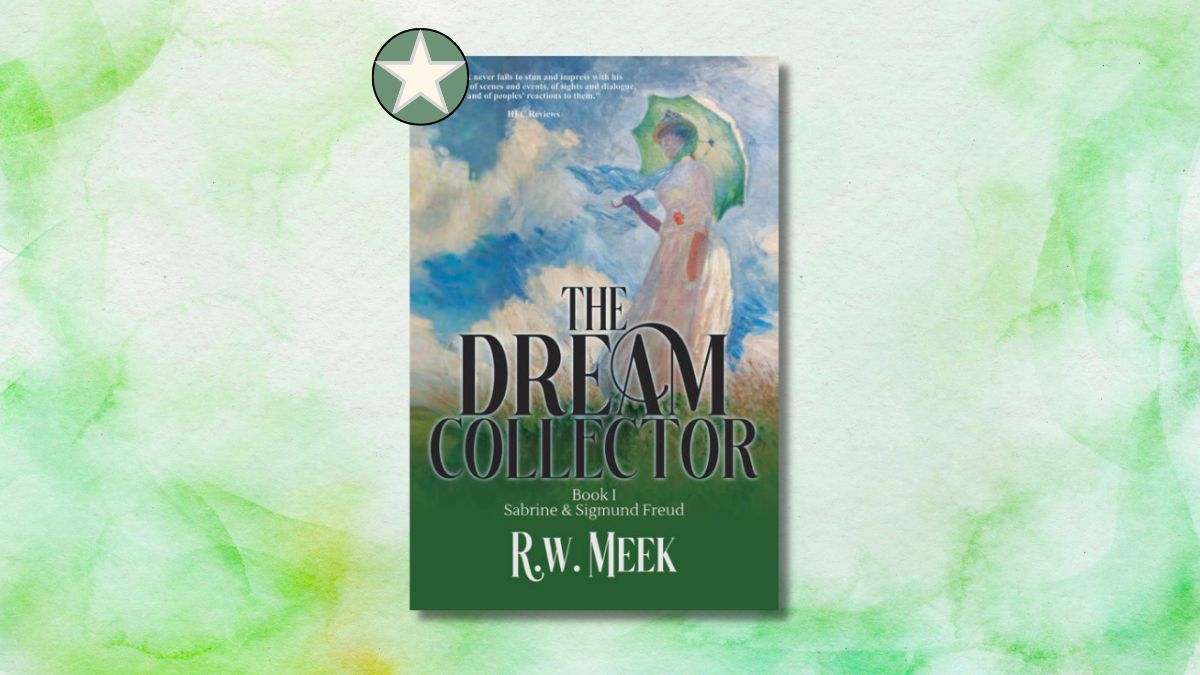
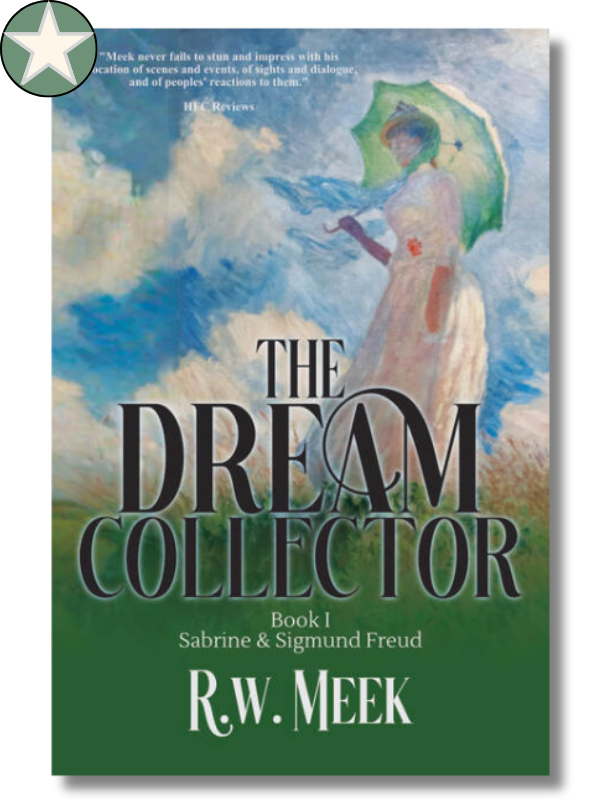
The Dream Collector
by R.W. Meek
Genre: Literary Fiction / Historical
ISBN: 9781962465144
Print Length: 556 pages
Publisher: Historium Press
Reviewed by Lauren Hayataka
A vivid portrait of passion, artistry, and the relentless pursuit of understanding the human mind.
R.W. Meek’s The Dream Collector: Book I Sabrine & Sigmund Freud thrusts readers into the dynamic ambiance of late 19th-century Paris where science and art entwine. Against the backdrop of the emerging Impressionist and Post-Impressionist movements, the story centers on Julie Forette, a self-educated woman from Marseilles. Her journey leads her to the notorious Salpêtrière, a sprawling hospital and asylum governed by the esteemed neurologist Dr. Jean-Martin Charcot.
Amidst the chaos of over five thousand disabled, demented, and abandoned women, Julie forges an unlikely friendship with the young intern Sigmund Freud. Together, they explore the conscious-altering power of cocaine, hypnotism, and dream interpretation, embarking on an urgent quest to find a cure for the star hysteric, Sabrine Weiss, before Dr. Charcot resorts to radical measures. As the narrative unfolds, Julie’s entanglements extend beyond the asylum, intertwining with major artists like Pissarro, Monet, and Degas, making the past come alive in an unforgettable way.
Impeccably researched, the novel presents an extraordinary blend of science and art, reason and passion, challenging readers through its vivid exploration of medical history and the prevailing beliefs surrounding hysteria. Viewed through the alternating perspectives of Julie and Sigmund, Dr. Jean-Martin Charcot emerges as a complex figure, revolutionary in his assertion that hysteria affects both men and women—an opinion that defies the traditional notion that hysteria solely afflicts women. Charcot, a perceptive and all-seeing individual, is described by Julie, now his stenographer, as the “God of Science,” revered for his masterful disease identification but paradoxically unable to endure even the slightest physical pain.
The dual nature of Dr. Jean-Martin Charcot is unsettling as he subjects his patients to humiliation in the pursuit of a cure. Conducting elaborate hypnosis sessions before enraptured audiences, ostensibly in the name of science and to secure funding for the Salpêtrière Hospital, Charcot’s actions are difficult to swallow. One of Charcot’s notable patients, Sabrine Weiss, is continually exploited and tortured in the name of scientific discovery. The novel meticulously portrays gruesome medical procedures, including hydrotherapy, electrotherapy, autopsies on infants, and the creation of an Ovarian Compressor, an invention as horrific as its name implies. The treatment scenes are one of the few times that one may wish that the author, Meek, wasn’t as skilled at bringing scenes to life in such incredible detail.
Julie assumes the role of a silent observer amidst the masters of art, surrounded by a whirlwind of famous faces and names, setting her apart. Some, like Suzanne Valadon, a model for countless artists, become her friends, while Camille Pissarro, a famed painter, stands as a father figure. Rather than a moth drawn to the light of others, Julie could be compared to a rat: fiercely intelligent yet driven by an obsession with art and dreams, clandestinely infiltrating artists’ rooms and rifling through their cupboards for glimpses of their creations. Julie acknowledges her fixation, describing her collection of dreams as an “idiosyncrasy”—her raison d’être—and exhibits no inclination toward fantasy. In her world, everything, even seemingly illogical actions, follows a logical thread woven by her deliberate intent.
At times, Julie emerges as an enigma—one that may be difficult for readers to decipher and connect with. Her affairs, first with the talented yet profoundly paranoid artist, Paul Cezanne, and later with another renowned artist, the exotic Paul Gauguin, appear more as an extension of her obsession with art and collecting dreams than genuine romance. Ironically, it seems that the eccentric Cezanne may have understood Julie more than anyone when he expressed his fears about their affair: “I’m terrified to leave. She might well walk out of my life. I shall be devastated. A painting is taking shape. Between us, a painting exists.”
And then there is Sigmund Freud, unlike you have ever seen him. Here he is young and ambitious, coming to Paris after securing an internship under Dr. Jean-Martin Charcot. Like many of the real figures in the novel, Freud comes alive in ways that one wouldn’t expect, as his weakness for sweets is exposed as well as the passionate letters he sends to his fiancé. Every person surrounding Sigmund and Julie comes brilliantly alive: from the art dealer, Theo van Gogh, who defended Impressionists when others hesitated to the arrogant yet terribly clever author, Emile Zola, and Charcot’s wickedly intelligent and vivacious wife and daughter. At times the personalities are overwhelming as they burst with life, each crowding the page as they demand one’s attention.
The same can be said for the novel itself. It overflows with numerous references to science and art, spanning from the emergence of Impressionism and its ties to Naturalism to Egyptology and the emerging tenets of Psychoanalysis. At times, readers may find themselves grappling to fully comprehend, as each reference and fact plays an integral role within the story. However, for those who persist, they will discover an incredible narrative—one that would have been an impossible undertaking for any other author. Meek clearly knew the story he wished to tell and dedicated every sentence to bringing it alive.
The Dream Collector: Book I Sabrine & Sigmund Freud is more than a historical novel—it is an outstanding example of what a novel should and can be. R.W. Meek’s meticulous research and narrative prowess weave a captivating tapestry of late 19th-century Paris, where the entwining forces of science and art come alive. Through the enigmatic Julie Forette, the complex figure of Dr. Jean-Martin Charcot, and the refreshingly human portrayal of the young and ambitious Sigmund Freud, Meek crafts a narrative that challenges readers to grapple with ethical dilemmas, historical complexities, and the intricate dance between reason and passion.
Thank you for reading Lauren Hayataka’s book review of The Dream Collector by R.W. Meek! If you liked what you read, please spend some more time with us at the links below.


What did you think?