


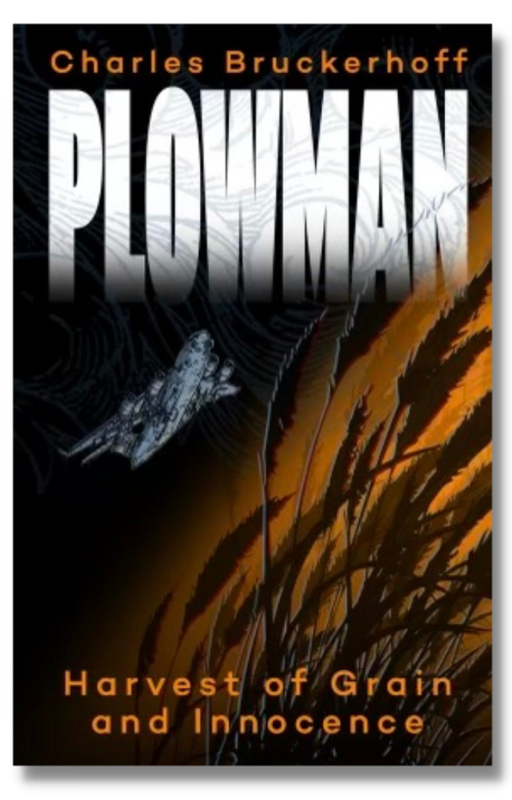
Plowman
by Charles Bruckerhoff
Genre: Historical Fiction
ISBN: 9780990583899
Print Length: 308 pages
Reviewed by Lauren Hayataka
An unflinching exploration of controversial wartime legacies, cherished childhood friendship, and the resilience of a close-knit community
Charles Bruckerhoff’s historical novel, Plowman: Harvest of Grain and Innocence, delves into America’s wartime legacy and moral dilemmas through the perspectives of childhood friends Stella Young and Hana Sanada. Their journey begins when they discover the wartime journals of their great-grandfathers from World War II and the Vietnam War. Motivated by this find, they embark on a mission to compile these stories into a manuscript, aided by their English instructor and theater director.
These journals serve as a bridge between the past and present, spanning the 1940s to the 1970s, and they help illustrate one of the central themes in the novel: the strength of a united community. It is vividly portrayed through the supportive staff at Stanton Academy for Humanity, where Stella and Hana attend school, as well as through Brother Blaine and his congregation members, who provide unwavering support to Stella’s family after her father’s tragic death in Afghanistan. The author portrays grief realistically, acknowledging that it doesn’t follow a specific timeline. The congregation also understands this, and their constant support for Stella’s family is wonderful to read.
The power of community retains its prominence even throughout dark moments in history, such as the shameful internment of Japanese Americans during World War II. Amidst the tragedy and loss experienced by countless families, the novel highlights the remarkable history of Hana’s family, the Sanadas, descendants of Sanada Nobushige, a prominent samurai clan leader. Despite being treated as enemies of the state, they agree to undertake a secret mission to help end the war with Japan, driven by a deep commitment to American freedom and democracy. Amidst squalor and inhumane conditions, the Sanada matriarch declares to Major Bradley: “We are proud Japanese American citizens…No. We are proud American citizens!”
One particularly moving moment is when Major Bradley observes interned families playing baseball, an enduring American pastime. My grandmother and her sisters also participated in baseball during their internment, and I cherish the golden whistle that she used while an umpire. The internment of Japanese Americans is an aspect of American history that has often been downplayed or ignored in World War II fiction, and its significance deserves recognition. If we do not learn from the past, how will we avoid making mistakes in the future? This is something that the author repeatedly explores throughout the novel, as he provides death tolls for World War II, the Vietnam war, and the war in Afghanistan—not only for American soldiers, but for the other side as well. What is the true cost of war? Is it worth it?
In parallel, the novel explores a second pivotal theme—the concept of American freedom and democracy—through a conservative, Christian-centric lens. As Stella and Hana transition to adulthood, their childhood ambition to create a manuscript remains unfinished, compelling them to revisit their purpose. Armed with firsthand accounts of World War II and the Vietnam War, as well as the profound impact of Stella’s father’s death, they begin to question the meaning and significance of their mission, and the legacy of America’s wartime involvement.
This questioning leads the women to take political action, culminating in a surprising ending that may resonate with some readers but leave others puzzled. The transition from their decision to engage politically to the story’s conclusion is marked by a significant departure from the earlier tone and may appear somewhat fantastical. Additionally, it’s important to note that the women’s political perspectives on contemporary leadership from the Obama administration to Biden’s administration and their positions on significant issues like immigration and inclusivity may challenge or even offend certain readers.
Overall, this shift in the novel’s conclusion appears to dilute its central themes, specifically, the power of community and the principles of American freedom and democracy. While the author adeptly introduces a diverse cast of characters who embody these themes throughout the story, the conclusion seems to deviate from the ideals of inclusivity. This shift in tone might leave some readers feeling unwelcome. Nonetheless, I commend the author for addressing often-overlooked facets of American history and remaining true to his creative vision.
Thank you for reading Lauren Hayataka’s book review of Plowman by Charles Bruckerhoff! If you liked what you read, please spend some more time with us at the links below.





What did you think?