

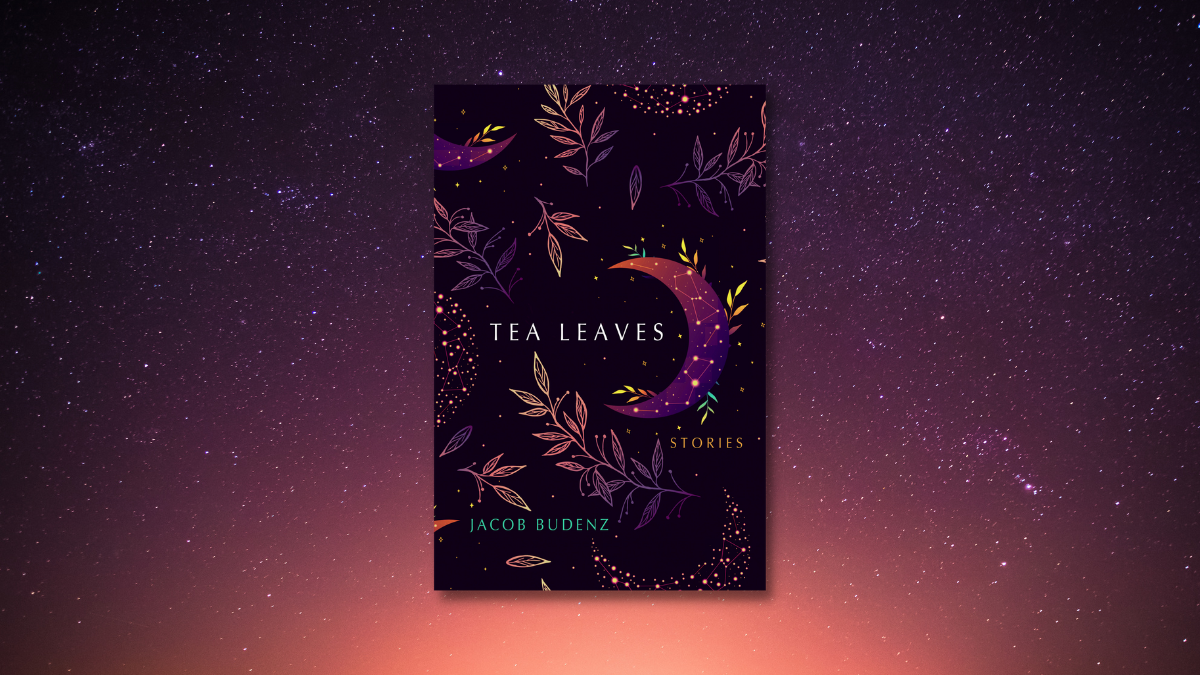

Tea Leaves
by Jacob Budenz
Genre: Literary Fiction / Short Stories
ISBN: 9781612942759
Print Length: 250 pages
Publisher: Bywater Books
Reviewed by Michael J. DeLuca
A finely observed and empathetic dive into queer relationships against a backdrop of supernatural horror
Jacob Budenz’s debut short fiction collection Tea Leaves is full of gay men and women who are deeply unsure of themselves and their roles in interpersonal relationships and the world, at times terminally so. It’s full of lapsed-Catholic guilt and self-recrimination, gleeful witchcraft, and the Delta South. If any of that sounds remotely accessible to you, I’m willing to bet you’ll find these stories–as I did–hitting unexpectedly close to home.
Budenz’s writing makes me uncomfortable in ways that taught me things about myself I didn’t know I still needed to learn: things about the impacts of prejudice and hate and the need to break from a destructive social status quo that assumes these rote cruelties as its default. The writing is eminently self-aware, wry, and subtle, satirizing straight (in both senses of the word) and corporate culture liberally, and I frequently found myself belly-laughing out loud in places and at ideas I entirely did not expect.
I’m not gay, I’m not a Southerner. I sure am a lapsed Catholic, with all that entails. Reading these stories, I feel like an awkward outsider being pulled behind the curtain–deep behind the curtain, and intimately close. Budenz is disarmingly, comfortably plain about bodies, physicality, lust, sex, dipping into the erotic and even the obscene with a precision that cannot be mistaken for anything but deliberate and pointed.
There’s a story here, “Trial,” through at least three-quarters of which the narrator is sitting on a toilet arguing with a Lovecraftian tentacle alien about what constitutes goodness and whether he himself falls under that umbrella or outside it, and the stakes are life and death. In one of my favorites in the collection, “Mask for Mask,” a shapeshifting potion helps an elder gay man comes to grips with the violence with which he pines for youth, and I come away fairly backhanded across the face with revelation about how I think and feel about my own aging, straight, male body.
I don’t often see lovers, long-term relationships broken and whole, even chance encounters between strangers portrayed with this kind of comfortable generosity or warmly illuminating attention to detail. Budenz has such sympathy for these poor saps and their partners and family and friends, treating their flaws with such generosity, somehow without flinching from them. It’s really a feat.
Tea Leaves also makes a profound case for humanity’s need for recrimination and reevaluation on a global scale: to grapple with its self-destructive tendencies, the polluting and poisoning of the earth, our causal role in climate collapse and systemic disconnection from nature, with welcome emphasis on the fact that we need to go on surviving, loving each other, finding meaningful work and making beautiful things amid that failing world.
I came across Jake Budenz’s writing when Reckoning (a journal of creative writing on environmental justice) included a poem of his, “Apology for the Divine Masculine,” in its post-Roe-v-Wade special issue on bodily autonomy, Our Beautiful Reward. In that poem, as here, Budenz displays an ability to cut down sharply through layers of societal, cultural, religious, and interpersonal finger-pointing and abdication of responsibility to the kernel of human self-concept they’re all competing to distort.
Despite the horror elements, the hauntings, the characters left here and there trapped in their own nightmares, the lingering question whether the whole human experiment has amounted to failure and the best thing to be done is struggle along waiting for God or Beelzebub or aliens or Nature to wipe the slate clean, I come away from Tea Leaves feeling supported, shored up. Ready to weather the doomscrolling and doubt for one more year.
The intimacy, patience and humor these stories teach has meant that long after closing the book, Tea Leaves keeps coming back to me. I hope you’ll read it, and–different as you and I and Jake Budenz and these characters inevitably must be–give it the chance to have something like the same impact on you.
Thank you for reading Michael J. DeLuca’s book review of Tea Leaves by Jacob Budenz! If you liked what you read, please spend some more time with us at the links below.

What did you think?